When purchases can avoid interest
If your card offers a purchase grace period and you are eligible for it, paying the full statement balance by the due date lets you avoid interest on purchases. Paying only part of that balance does not preserve the same protection. Before relying on interest-free time, check whether your account currently has a grace period and what your agreement requires.
The grace period is the window between the end of a billing cycle and the payment due date. Issuers are not required to offer one, although most cards provide one for purchases. It is a conditional interest benefit, rather than a promise that every transaction gets a fixed number of interest-free days.
Issuers must establish procedures to ensure bills are mailed or delivered at least 21 days before payment is due. That statement-delivery rule is separate from whether a transaction qualifies for a grace period. Receiving a bill weeks before its due date does not make an otherwise interest-bearing cash advance interest-free.
Why two purchases can get different amounts of time
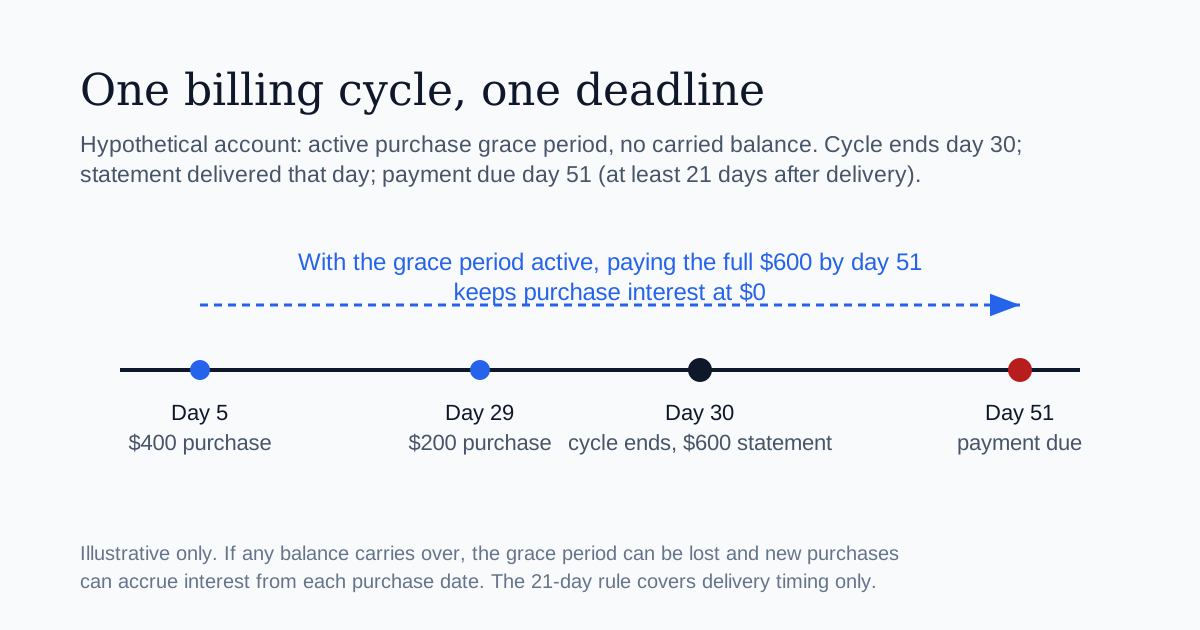
Consider a hypothetical account with an active purchase grace period. Its billing cycle ends on day 30, the statement is delivered that day, and payment is due on day 51. Assume there are no other balances. A $400 purchase on day 5 and a $200 purchase on day 29 both appear on the $600 statement.
Scroll sideways to see every column.
| Purchase | Time until the day-51 due date | Payment condition |
|---|---|---|
| $400 on day 5 | 46 elapsed days | Included in the $600 statement balance |
| $200 on day 29 | 22 elapsed days | Included in the same $600 statement balance |
Paying the full $600 by day 51 avoids purchase interest under these assumptions. The arithmetic is 51 − 5 = 46 days for the first purchase and 51 − 29 = 22 days for the second. The purchases receive different amounts of time because they share a statement deadline, not because each transaction starts its own identical countdown. Neither interval is a promised grace-period length for another card.
What changes when you leave a balance unpaid
If you lose the grace period by not paying your balance in full by the due date, interest applies to the unpaid portion. Purchases in the new billing cycle also start accruing interest from the date each purchase is made. The consequence therefore extends beyond the amount left from the previous bill.
In the $600 example, paying $599 leaves $1 unpaid. That small shortfall is not a way to retain the full-payment benefit. If it causes the grace period to be lost, a new $300 purchase can start accruing interest from its purchase date as well. The important comparison is the cost of leaving a balance plus the effect on new spending—not simply the interest on the remaining $1.
If you cannot pay in full, consider pausing new purchases on that account and using funds already available for everyday spending. Ask the issuer what payment is needed to regain the purchase grace period and when it will take effect. The supplied CFPB guidance does not establish a universal restoration timetable, so do not assume one full payment immediately restores it.
How the daily balance changes the cost
Many issuers calculate interest daily using daily account balances and a daily periodic rate. That means both the amount owed and the number of days it remains outstanding matter. Your actual rate and calculation method come from your account terms; the following example uses an assumed daily rate, not an available offer.
Assume a balance subject to interest is $600 for 10 days and $900 for the next 20 days. Use a hypothetical daily periodic rate of 0.05%, or 0.0005, and assume no fees, payments or compounding during these 30 days. The average daily balance is [($600 × 10) + ($900 × 20)] ÷ 30 = $800. Interest is $800 × 0.0005 × 30 = $12.
Checking the two periods separately gives the same result: $600 × 0.0005 × 10 = $3, and $900 × 0.0005 × 20 = $9. Together they total $12. Using only the ending $900 balance for all 30 days would produce $13.50 and overstate this example's cost. The extra $300 was outstanding for only 20 days, illustrating why transaction and payment timing affect interest.
Cash advances and mixed balances need separate attention
Grace periods typically apply only to purchases. Getting cash with the card or using a check received from the issuer generally starts interest on the transaction date. Paying the next statement in full therefore does not necessarily make those transactions interest-free.
Your statement must show each balance category with a different annual percentage rate, or APR, and the balance in that category. When you pay more than the minimum but less than the full balance, the amount above the minimum generally goes first to the highest-rate balance. That rule does not say the whole payment goes there, or that a partial payment preserves your purchase grace period. Review the categories separately rather than treating the card as one balance with one interest rule.
Check the bill before relying on interest-free time
- Find the statement balance and due date, and plan whether you can pay that balance in full.
- Check the agreement or ask the issuer whether your purchase grace period is currently active.
- Look for separate balance categories and APRs, especially after taking cash or using an issuer check.
- If full payment is out of reach, assess new spending separately: another purchase may add interest from its transaction date.
- Ask how your payment will be allocated and what is required to restore any lost grace period.
If you are comparing ways to finance purchases, use the introductory-APR category as a starting point for reviewing terms. A purchase grace period depends on full-payment conditions; do not assume it works like a separately advertised introductory rate.
Sources and further reading
Sources checked October 26, 2026.
- CFPB: What is a grace period for a credit card?CFPB Ask page checked October 26, 2026.
- CFPB: How does my credit card company calculate the amount of interest I owe?CFPB Ask page, last reviewed January 22, 2024, checked October 26, 2026.