Price the same repayment plan on both sides
A balance transfer can be worth its fee when the interest you would otherwise pay exceeds the cost of moving the debt. Compare both choices using the same repayment budget and timeline. A zero introductory rate alone cannot tell you whether moving a particular balance saves money, especially if you could repay the old account quickly.
The official pages checked on October 29 show that introductory periods differ and that a transfer fee applies. One page describes 18 months at a zero introductory transfer APR; another lists options with 15 or 12 months. These are dated examples of why the deadline matters, rather than a promise about the terms you will receive. Read the specific offer before making a decision.
Convert the fee into dollars first
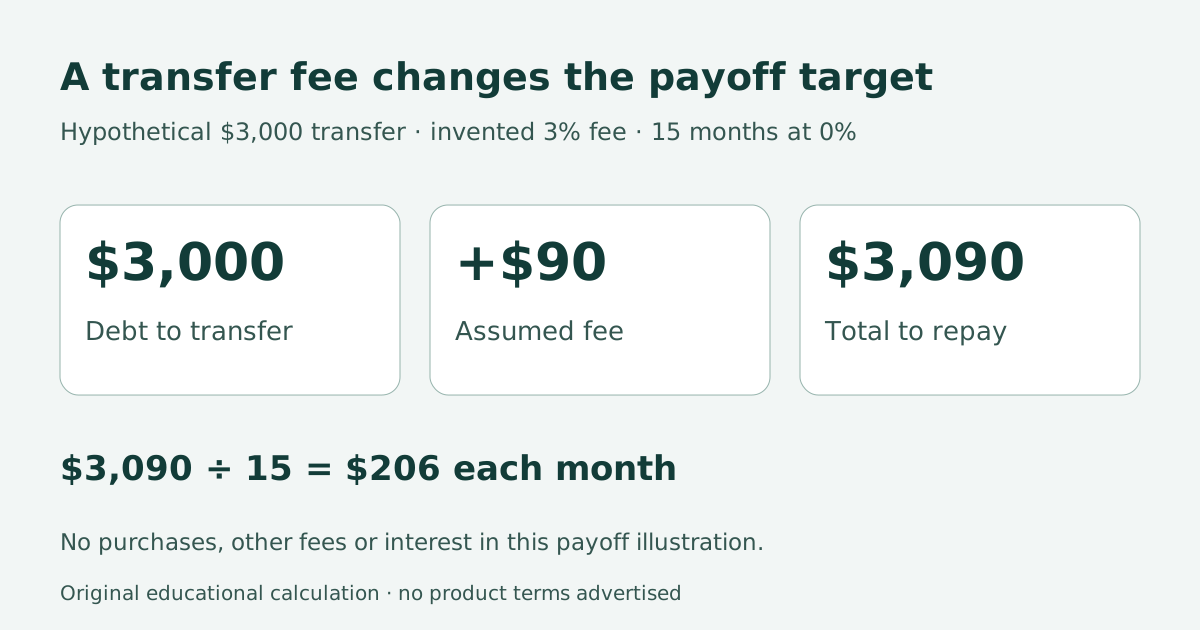
Use a hypothetical $3,000 balance and an invented 3% transfer fee. Multiplying $3,000 by 0.03 gives a $90 fee. If that fee is added to the amount you must repay, the starting balance becomes $3,090. Confirm how an actual offer handles its fee before using that total in a payment plan.
The source pages establish that fees apply, but the excerpts do not provide a fee percentage or minimum. Our 3% assumption therefore describes no available product. Ask for the actual percentage, any minimum dollar charge, the transfer deadline and which transactions qualify. Replace the illustration with those figures before deciding. A small advertised rate cannot substitute for the missing fee calculation.
Estimate interest on a shrinking balance
For a transparent comparison, suppose the old account charges an invented fixed 24% APR. Model each month as APR divided by twelve, or 2%, applied to that month’s starting principal. Assume you reduce principal by $250 at each month’s end for twelve months, pay that month’s interest separately, and make no new purchases. This is an arithmetic model, not a prediction of an issuer’s interest method.
The monthly starting principals are $3,000, $2,750, $2,500 and so on down to $250. Their sum is $19,500. Multiplying that sum by 2% gives $390 of modeled interest. Against a hypothetical $90 transfer fee and no other transfer costs, the difference is $300. The illustration identifies the comparison to make; it does not establish your actual saving.
A short payoff horizon changes the result
Now keep the same invented balance and rate but assume you pay all $3,000 at the end of the first modeled month. Interest is $60 under our assumptions. Paying a $90 transfer fee to avoid that $60 would cost $30 more. A transfer that looks attractive over a year can be unattractive when repayment is only weeks away.
A rough screening calculation divides the fee by modeled monthly interest on an unchanged balance: $90 divided by $60 equals 1.5 months. That is not an exact break-even date. Payments reduce the balance, real billing dates matter, and the assumed monthly method may differ from the account’s method. Use your statements and intended payment dates for a more useful estimate than simply multiplying today’s balance by a full year’s APR.
Build the payment around the actual deadline
At a zero introductory rate, clearing a hypothetical $3,090 in fifteen equal monthly payments requires $206 per month. Over twelve months it requires $257.50; over eighteen months it requires about $171.67, with a final rounding adjustment. These figures assume the entire balance receives that rate, the fee is included, and nothing else is charged. They exclude every cost beyond the invented fee.
Compare the required amount with money already available in your budget. If you can set aside only $180 monthly for fifteen months, you would pay $2,700 and leave $390. That remaining amount needs a plan beyond the introductory deadline. The cited pages say a variable APR applies afterward. Do not assume the balance will remain interest-free or that another transfer will be available when you need it.
Keep purchase and transfer terms separate
One checked page offers eighteen introductory months for transfers and six for purchases. That difference is enough to make a single “zero percent” label misleading for planning. Identify which balance gets which period. This comparison concerns moving existing debt; it does not establish the cost of adding purchases to the receiving account.
Keep the worksheet simple: write the old balance, quoted fee in dollars, applicable introductory transfer period, post-introductory terms and planned monthly repayment. Ask how the introductory clock is measured, when a requested transfer must be completed and what other conditions apply. Those details were not captured in the excerpts, so there is no assumed deadline rule here. Avoid building a plan around an answer that your actual offer has not supplied.
Make the decision before submitting the transfer
A useful decision has two parts: the estimated saving is positive under reasonable assumptions, and the required repayment fits your budget. Repeat the comparison with a faster old-account payoff and a smaller monthly budget. If the benefit disappears under either change, understand how much room your plan really has.
Use the balance-transfer calculator for a second arithmetic check, entering the actual fee and rates yourself. Choose the repayment amount and target date before requesting a transfer. Keep the offer you relied on so you can compare the eventual account terms with your worksheet. The goal is a lower total cost for debt you already have, supported by a payment plan you can carry out.
Give yourself a margin in the schedule if your income varies. Dividing by fewer months increases the planned payment but reduces dependence on the last payment arriving exactly when expected. This is a budgeting choice, not a change to the provider’s deadline. Use the date in your actual offer when you set reminders.
Sources and further reading
Sources checked October 29, 2026.
- Official provider page: introductory transfer periods and fee disclosureOperator source pack: fetched October 29, 2026, 8:38–8:40 p.m. EDT; publication/effective date not supplied.
- Official provider page: transfer introductory periods and subsequent variable APROperator source pack: fetched October 29, 2026, 8:38–8:40 p.m. EDT; publication/effective date not supplied.