Put the payment ahead of the headline rate
A balance transfer can reduce the cost of existing debt. Its usefulness comes down to a less exciting number: the payment you can keep making until the balance is gone. Work that out before applying, while you can still decide that the plan does not fit.
Start with what you can afford after housing, food, transport, other debt payments, and a reasonable cushion. A plan that works only if every month goes perfectly leaves little room for a repair bill or a smaller paycheck.
The fee belongs in the payoff amount
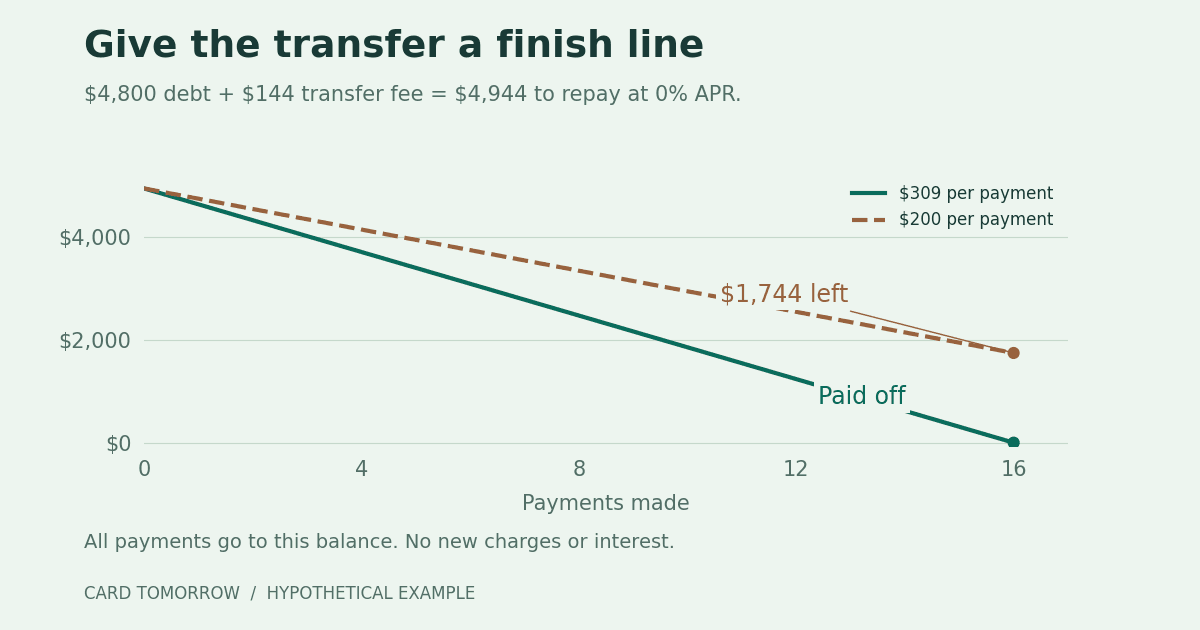
Suppose you transfer $4,800 with a 3% fee. The fee is $144, making the starting balance $4,944 if it is added to the account. For this example, assume a 0% rate covers both amounts, there are no other charges, and all payments go toward this balance.
If you have 16 payment dates before your target payoff date, $4,944 divided by 16 is $309. Paying $200 on each of those dates would repay $3,200 and leave $1,744. A lower required minimum does not make that remaining debt disappear.
| Payment dates available | Payment each time | Total repaid |
|---|---|---|
| 16 | $309 | $4,944 |
| 12 | $412 | $4,944 |
| 8 | $618 | $4,944 |
Count actual payment dates
Find the date the promotional rate ends and choose an earlier target for finishing the payoff. Count the monthly payment dates that fall before your target. That count is more useful than dividing by the number of months in an advertisement, especially after time has passed since the account opened.
Check the deadline for requesting a qualifying transfer separately. Also confirm the permitted transfer amount, the fee, and which debts can be moved. Leave room for the fee when assessing the available credit. Approval for a new account does not establish that the entire transfer will be accepted.
Keep paying while the transfer is processing
Continue making required payments on the old account until the transfer is confirmed and you have checked the remaining balance. Processing takes time. Interest or another charge can leave a small amount behind even after the main balance moves.
On the new account, pay at least the statement’s required minimum on time, even if your planned payoff amount is different. Review the balance after each statement so a fee, missed payment, or change in allocation does not quietly put the plan behind schedule.
Keep new spending out of the calculation
A transfer promotion may not cover purchases. Carrying the transferred balance can also affect the grace period for new spending. Unless the account terms clearly support a combined plan, keep the transfer account focused on the debt you are paying down.
Compare the transfer fee and any other costs with the interest you would pay by staying on the old account under the same payment budget. If you would finish paying the old balance very soon, the fee could erase the benefit of moving it.
Use a payment you can sustain
The $309 figure is useful because it turns a promotion into a budget decision. If that payment is comfortable, you can compare transfer terms against the plan. If it is not, change the plan before taking on a new account; do not assume another promotion will be available when this one ends.
The balance-transfer category is the place to compare fees, timing, and eligible debt. Keep your payoff amount beside you as you review the terms.
What payment clears the balance?
Estimate a payoff plan at 0% interest. Use payment dates that fall before your target payoff date.
$309.00 per payment for 16 payments.
$144.00 transfer fee · $4,944.00 total to repay.
Assumes the fee is added to the balance, 0% covers the full amount, and every payment reduces this balance. Excludes other fees, new spending and interest. Your statement’s minimum is still due on time. Inputs stay in your browser.
Sources & further reading Checked September 15, 2026
- Transfer fees and total borrowing costProvider reference; no publication date shown.
- Transfer eligibility, payment allocation, and purchase interestCurrent provider FAQ; no publication date shown.
- Transfer processing and remaining balancesProvider reference; no publication date shown.
- Minimum payments during an introductory rateSource dated August 18, 2026.