Compare the trip you would actually buy
A points balance can make a trip feel almost paid for. Before redeeming it, compare the full cash option with the full points option for a trip you actually want. The goal is to understand what you gain by using points, not to produce the highest looking number from an expensive trip you would never buy.
Match the travel dates, route or location, and the features that matter to you. For a flight, that may include baggage, seat choice, and change rules. For a stay, compare the same number of nights and room requirements. A cheaper option with an inconvenient arrival or a restrictive cancellation policy is a different purchase, even when the destination matches.
Write down the total cash price and every cash charge that remains with the award booking. Points do not necessarily cover taxes, carrier charges, or other fees. Use the actual checkout information rather than assuming that a headline “free” flight or night has no cash cost. Keep the comparison in one currency.
Calculate how much cash your points replace
For comparable bookings, subtract the award’s cash charges from the cash price, divide by the number of points used, then multiply by 100. The result is cents of cash replaced per point. This is a comparison measure for that booking, not a promise that your points have the same value everywhere.
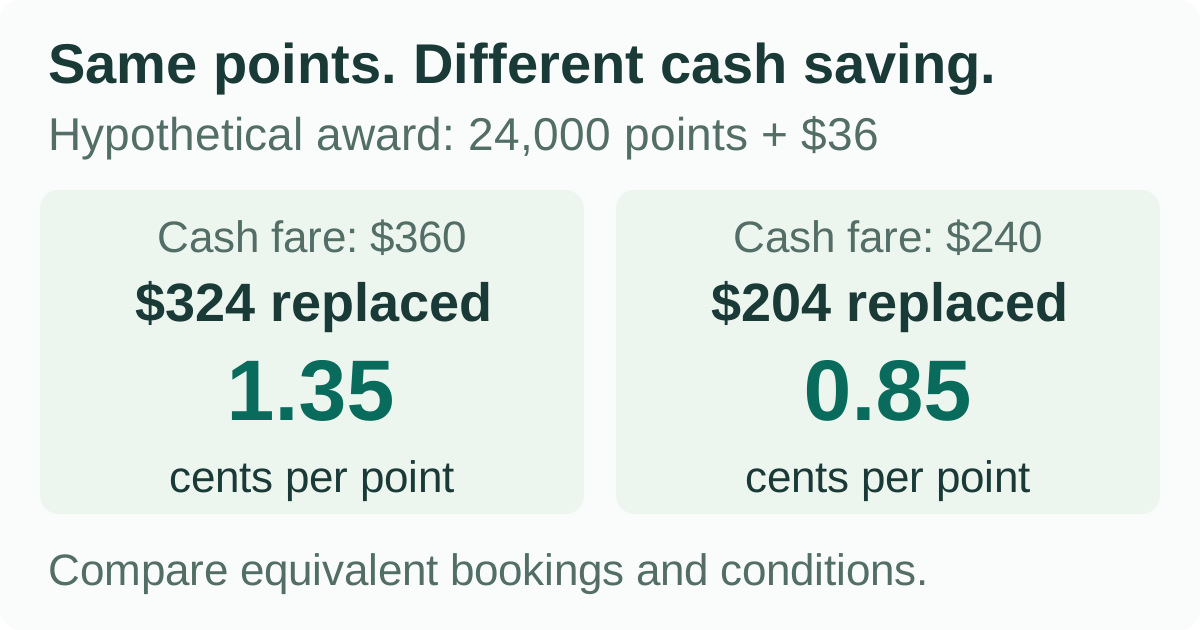
Suppose the trip costs $360 in cash or 24,000 points plus $36. The points replace $324 of spending: $360 minus $36. Dividing $324 by 24,000 gives $0.0135 per point. Multiplying by 100 expresses that as 1.35 cents per point. The example assumes the two bookings offer the same features you need.
The subtraction matters. Dividing the full $360 by the points would count the remaining $36 as a saving even though you still pay it. Keep the dollar and cent units visible as well: $0.0135 and 1.35 cents are the same amount. A decimal mistake can make a modest redemption look one hundred times more valuable.
Recheck when the cash fare changes
Now suppose the comparable cash price falls to $240 while the award still needs 24,000 points and $36. The points replace $204, producing 0.85 cents per point. The points price has not changed, but its usefulness relative to paying cash has. A calculation saved last week may no longer describe the booking in front of you.
Scroll sideways to see every column.
| Cash price | Points plus cash | Cash replaced | Value per point |
|---|---|---|---|
| $360 | 24,000 points + $36 | $324 | 1.35 cents |
| $240 | 24,000 points + $36 | $204 | 0.85 cents |
Use a cash alternative you would realistically choose. If an equivalent, practical itinerary costs $240, comparing the award only with a $360 option can overstate the savings relevant to your decision. If the cheaper booking is worse in a way that matters, describe that difference instead of pretending the options are identical.
Ask what else those points could do
Using points has an opportunity cost: you give up another available use for them. That does not mean there is one correct value for every traveler. It means you should compare this redemption with the alternatives you can actually access under your program’s terms, including another planned trip or a cash redemption if offered.
For illustration only, assume your program lets you redeem 24,000 points for exactly $240 in cash. Against the $360 trip, using the points plus $36 produces $324 of travel savings, $84 more than that hypothetical cash option. Against the $240 trip, the award saves $204, which is $36 less than the hypothetical $240 cash redemption.
Those figures do not describe a current offer, and a statement credit may have different rules from cash. Check the redemption option and any restrictions before using it as your benchmark. If you have no practical alternative use, do not invent one just to justify holding points. Compare choices you would genuinely be willing and able to make.
Compare the rules as carefully as the price
Read the cancellation, change, and refund conditions of each exact booking. A cancellation might return points, create a travel credit, involve a fee, or have other restrictions depending on the program and fare. Do not infer award rules from a cash ticket on the same route or from a previous booking.
Imagine one option costs $30 more but gives you a cancellation outcome you can actually use if your plans change. The lower displayed price is not the whole decision. Write down what you would receive after canceling and any deadline for doing so. That turns vague “flexibility” into a feature you can evaluate for your situation.
Also check whether the cash and award bookings earn different rewards or qualify for different benefits. The simple cents-per-point calculation does not include those differences. You can note a known difference separately, but avoid counting speculative rewards or giving an unwanted benefit a large dollar value just to make one option win.
Check availability before moving points
If redemption requires transferring points to another program, check the transfer terms and the bookable award first. Transfers can be final and may take time; the primary provider example linked in the sources has both conditions. Treat that as a reason to check your own program, not as a universal timetable for every transfer.
Confirm the destination program, the transfer ratio, any required increments, and the number of points actually needed. Verify that the traveler or account details meet the program’s requirements. A displayed transfer bonus is not enough by itself: the award must still be available on terms you are willing to accept.
Consider what you would do if the award disappeared or changed price before the transfer finished. If the transferred points would then be stranded in a program you rarely use, that risk belongs in the decision. Keeping flexible points where they are until you have a concrete booking plan can be more useful than chasing a headline valuation.
Keep the calculation within its limits
There is no single cents-per-point threshold that makes a booking right for everyone. Someone preserving cash for essential expenses may value reducing the cash portion differently from someone with ample travel savings. That still calls for checking the remaining fees and whether the trip itself fits the budget.
Do not spend more merely to create a higher redemption figure. A larger saving against a premium trip does not mean you saved that amount from your own budget if you would otherwise buy a less expensive trip. Similarly, a points redemption does not offset interest or annual fees automatically; those account costs need their own comparison.
Make the booking decision in dollars first
Before booking, record four things: the cash alternative you would buy, the points required, the cash still due, and the rules that differ. Calculate the cash replaced, compare a realistic alternative use of the points, and choose the option you can afford. A useful redemption makes your actual trip easier to fund without hiding a cost you will regret later.
Sources and further reading
Sources checked September 17, 2026.
- Provider education: comparing miles with cashNo publication date displayed; checked September 17, 2026.
- Provider education: miles, redemption value and remaining chargesNo publication date displayed; checked September 17, 2026.
- Provider education: reward currencies and redemption optionsSource dated March 12, 2026.
- Provider guidance: transfer finality and checking award availabilityCurrent primary guidance inspected September 17, 2026.