The currency button is a price decision
At a foreign checkout, being offered a price in U.S. dollars can feel reassuring. It can also mean accepting the merchant’s exchange rate and conversion charges. This service is called dynamic currency conversion.
Choosing the local currency declines that conversion service. Your card’s payment network or issuer then handles the conversion under its own terms. That is a useful default when you want to avoid paying the merchant for an extra conversion step.
A foreign transaction fee is a different charge
A foreign transaction fee comes from your card account’s terms. It can apply to a purchase abroad or an online purchase from a foreign merchant. You do not necessarily have to leave the country to encounter it.
Selecting local currency does not remove an issuer’s foreign transaction fee. Having a card without that fee does not stop a merchant from offering currency conversion. Make the two decisions separately: which account you use, and which currency you approve at checkout.
Compare dollars, not the reassuring wording
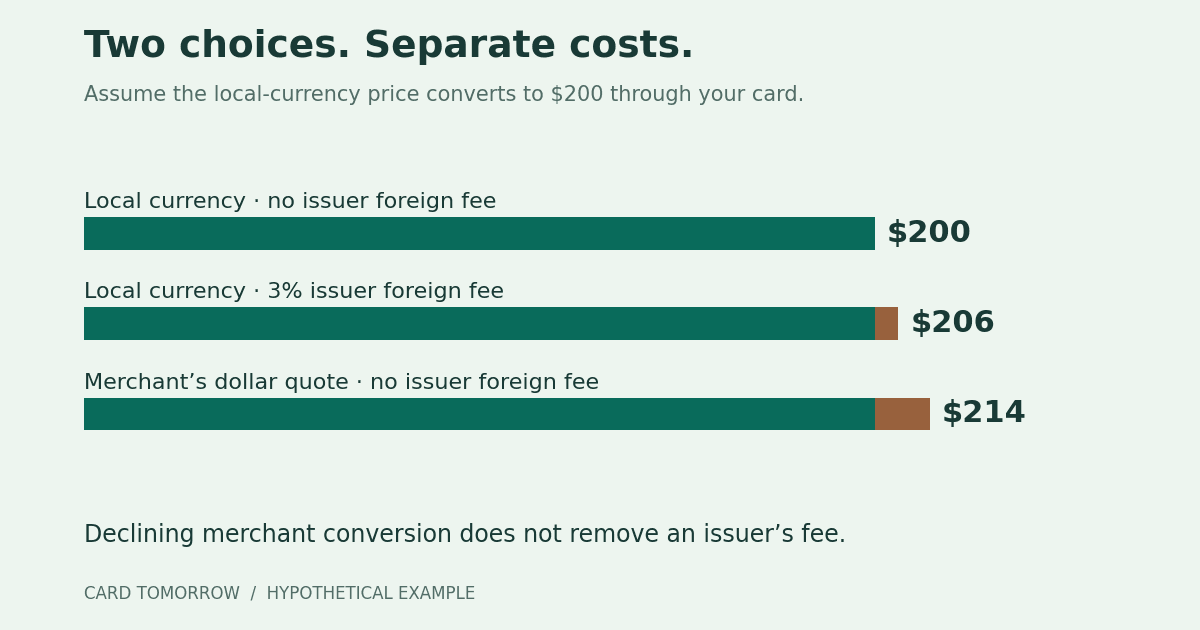
Suppose the local-currency price would convert to $200 through your card. With no issuer foreign transaction fee, the example costs $200. With a 3% issuer fee, it costs $206: the $200 purchase plus $6.
Now suppose the merchant instead offers to charge $214 in U.S. dollars. On a card with no issuer foreign transaction fee, that is $14 more than the example’s $200 local-currency route. A fee-free card would not recover those $14 for you. These are invented comparison amounts; actual exchange rates and quotes change.
| Payment choice | Issuer foreign fee assumed | Total |
|---|---|---|
| Local currency; card converts to $200 | None | $200 |
| Local currency; card converts to $200 | 3% of $200 = $6 | $206 |
| Merchant offers a $214 U.S.-dollar quote | None | $214 |
Check the currency before you approve
Read the terminal or checkout screen before confirming. If someone has selected U.S. dollars for you, ask to use the local currency. Keep a receipt showing the amount and currency you agreed to, particularly for a large hotel or rental-car payment.
A merchant’s conversion quote and a live exchange-rate search are not a guaranteed prediction of the amount your issuer will post. Use the quote to understand what you are accepting, rather than treating a familiar dollar figure as proof of a fair price.
Choose the account before you pack
Find the foreign transaction fee in the account’s rate-and-fee disclosure. Then estimate it against the international spending you already expect. For example, a 3% fee on $2,000 of covered purchases is $60. That calculation gives the fee a place in the budget instead of leaving it as a small-looking percentage.
Compare that cost alongside any annual fee and rewards you will actually use. A short trip and frequent international purchases may lead to different choices. The no-foreign-transaction-fee category helps you focus on the account charge; the travel-rewards category adds the earning and redemption questions.
Treat cash withdrawals separately
An ATM withdrawal is a different transaction from buying dinner or paying a hotel bill. Check cash-advance charges, interest, and ATM operator fees before using a credit card for cash. Bring a backup payment method so one declined transaction does not force a costly last-minute choice.
Sources & further reading Checked September 15, 2026
- International payments and merchant currency conversionSource dated August 11, 2026.
- Foreign transaction fees and online purchasesSource dated March 12, 2026.
- CFPB: purchase grace periods and cash advancesFoundational reference; reviewed September 23, 2024.
- Payment-network guidance on currency choice and receiptsCurrent network guidance; no publication date shown.