Start with the alternative
An annual fee can accompany extra rewards or benefits. Whether those extras justify the cost depends on how you use the account. Covering the fee is only the first question; you also need to compare what another card would return.
Use the same planned purchases for both options. Cash-back programs can use different earning rates, spending categories, caps, and redemption rules. A headline percentage alone cannot capture those differences.
A $90 fee, worked through
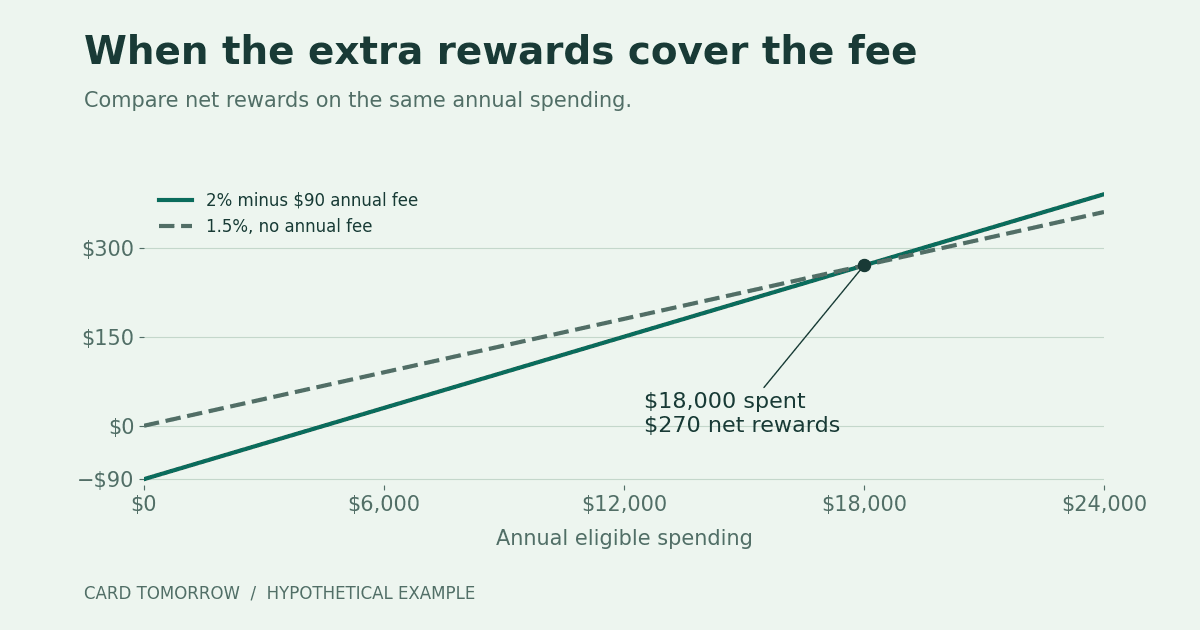
Consider two imaginary cards: one returns 2% on eligible purchases and charges $90 a year; the other returns 1.5% with no annual fee. Assume all of your spending qualifies, rewards have the same cash value, and neither program has a cap.
The extra return is 0.5 percentage points, or $0.005 per dollar. Divide the $90 extra fee by 0.005: the break-even point is $18,000 in annual eligible spending. At that amount, each option leaves $270 after the annual fee.
| Annual eligible spending | 2% minus $90 | 1.5%, no annual fee |
|---|---|---|
| $6,000 | $30 | $90 |
| $12,000 | $150 | $180 |
| $18,000 | $270 | $270 |
| $24,000 | $390 | $360 |
Use the difference, not the full reward rate
For two flat-rate options with the same redemption value, divide the additional annual fee by the additional earning rate expressed as a decimal. That gives the eligible spending needed to cover the difference in fees.
If the more expensive option has no higher earning rate, this formula does not produce a useful positive threshold. Compare usable benefits separately. If rates vary by spending category, calculate rewards for each category first rather than applying one rate to the whole budget.
What can change the result?
A welcome bonus belongs in a first-year calculation; it should not be counted again in every later year. Give a benefit only the value it has to you, after any extra spending needed to use it. Check current terms for eligibility, caps, and redemption limits.
Interest and other charges can outweigh rewards. A no-annual-fee account can still have borrowing or transaction costs. This table assumes those costs are zero, so it is not a total-cost estimate for someone carrying a balance.
Make the comparison with your own budget
Take one ordinary month of planned spending, extend it to a year, and separate purchases that earn different rates. Compare the resulting rewards after fees. Do not add purchases just to pass a break-even threshold.
- Record the annual fee and whether an introductory waiver ends.
- Check each earning rate, cap, and redemption condition.
- Keep first-year bonuses separate from ongoing value.
- Compare interest and other charges alongside rewards.
Sources & further reading Checked September 15, 2026
- Provider education: annual fees and rewards valueSource dated March 24, 2026.
- Provider education: earning and redeeming cash backSource dated June 16, 2026.
- CFPB: interest, grace periods, and account termsFoundational reference; last modified December 28, 2022.