Check the calendar before changing your spending
Rotating cash back can be worthwhile when the bonus categories match purchases you already make and the extra reward justifies the tracking. Start with your usual spending, then check activation, eligible transactions, the cap and the earning period. A high rate on a category you rarely use may add very little.
The category changes from one earning period to another. Some programs require you to activate each quarter, while activation deadlines and the treatment of earlier purchases differ. Check the current terms in your own account; another card’s calendar or last quarter’s rules may not apply.
Record both the activation deadline and the period in which transactions must qualify. Save the activation confirmation. Do not assume that enrolling late recovers every earlier purchase, or that activating once covers future quarters.
A high rate usually needs context
A spending cap limits how much can earn the higher rate. Check whether it covers all bonus categories together and what rate applies afterward. Also check whether the stated bonus includes the regular earning rate.
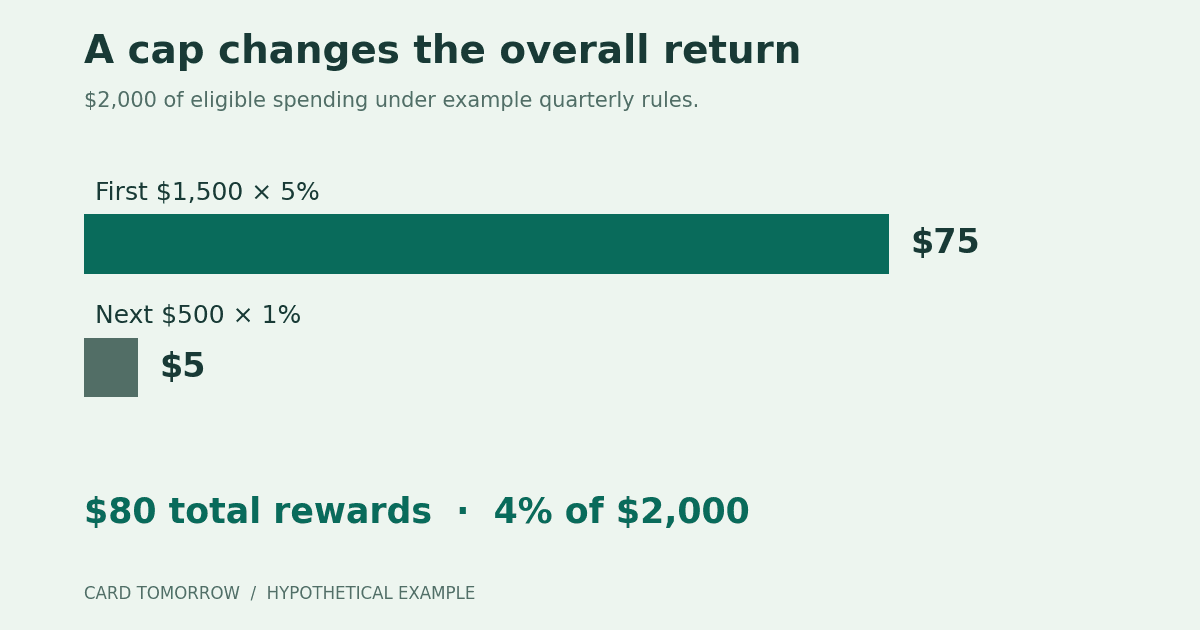
Here is an illustration, not an offer: suppose 5% applies to the first $1,500 of eligible quarterly purchases and 1% applies afterward. On $2,000 of eligible purchases, the rewards would be $75 plus $5, or $80. That is 4% across the full $2,000, not 5%.
The cap may cover several bonus categories together. In a hypothetical quarter with a combined $1,500 limit, $900 in one eligible category leaves $600 of higher-rate capacity for the others. It does not create another $1,500 allowance for each category.
Also check whether the headline rate includes the ordinary earning rate. If an offer describes a total of 5%, counting 5% plus a separate 1% base rate would overstate the return. Use the total rate specified for that particular transaction.
Measure the extra reward over a simpler option
Use the same $2,000 budget for a fair comparison. Assume a second imaginary account earns a flat 2% on every purchase with no cap. It would return $40. The rotating example returns $80 when all $2,000 qualifies for its categories, so the extra return is $40 before interest, fees or other benefits.
Now suppose only $500 of that budget qualifies for the 5% category, with the other $1,500 earning 1%. That gives $25 plus $15, or $40: the same as the flat 2% alternative. The category percentage has not changed, but its usefulness to this budget has.
These invented terms assume equal cash redemption value, all transactions qualify at the stated rates, activation requirements are met, and there are no other rewards or costs. Real accounts may have additional permanent categories or different caps; calculate those separately.
Scroll sideways to see every column.
| Spending mix | Rotating example | Flat 2% example |
|---|---|---|
| $2,000 in bonus categories; $1,500 cap | $80 | $40 |
| $500 in bonus categories; $1,500 at 1% | $40 | $40 |
A store name does not settle eligibility
Rewards depend on the program’s transaction rules. Review merchant categories, exclusions, payment methods, and any booking requirements. A purchase that sounds like it belongs in a category may be classified differently.
Before making a large purchase, read the relevant terms and keep the confirmation. After it posts, check the rewards earned. Contact your provider if the result does not match the terms; this website cannot view or adjust your account.
A grocery item bought in a general retailer does not necessarily earn a grocery-category rate. Programs commonly rely on the merchant classification transmitted with the transaction, rather than identifying each item in your basket. The merchant’s name or website description cannot settle the result on its own.
A third-party checkout or payment service can also affect the information passed to the rewards program. That does not mean every digital wallet fails to qualify. Read the account’s specific exclusions and check a posted transaction instead of treating a payment method’s familiar logo as proof either way.
Check when the purchase and the reward count
An order placed just before a quarter ends may be submitted or posted later. Programs define the relevant timing in their terms. If a purchase is close to the deadline, do not rely on a checkout date alone as proof that it qualifies. Avoid bringing forward spending you cannot comfortably pay just to reach that date.
A returned or refunded purchase can reduce earned rewards. Reconcile the refund and reward adjustment when checking the next statement. Do not assume that a return creates fresh cap capacity for another transaction unless the program’s rules confirm it.
Earned rewards may also take time to become available. Check redemption options and value before counting them as cash. A reward statement credit can lower the balance without necessarily satisfying the required payment; use the amount the account says is still due. Rewards do not replace a funded payment plan.
Save four details
Keep a short note with the rules for the coming quarter. This is easier to use than a saved headline percentage.
Use a note you can check in a few seconds before a purchase. Include how much of the higher-rate cap remains, not just its original size. Review the posted rewards after a large transaction or return so the note reflects what the program actually counted.
- Activation: the deadline, confirmation, and whether earlier purchases can qualify.
- Eligibility: the exact categories and excluded transactions.
- Limits: the combined spending cap and the rate beyond it.
- Timing: the earning period and whether the transaction must post before it ends.
Keep the routine worth the effort
Use purchases already in your budget. The example’s $80 is a reward on $2,000 spent, not a reason to spend $2,000. Compare rotating rewards with a simpler earning structure if activation and category tracking are difficult to maintain.
Always include interest and fees in that decision. Read current account terms before relying on a reward. This article explains the comparison method; it does not list current quarterly offers.
Decide using the extra reward over a realistic alternative. In the comparison, the most favorable spending mix adds $40 over a flat 2% option for the quarter. If changing retailers, paying delivery charges or missing a better price costs more than $40, the bigger category percentage has not improved the purchase.
There is also no need to spend up to a cap. A cap is a limit on favorable earning, not a target for your household budget. If your spending does not match, use an account that fits the transaction you were already going to make. Review the cash-back category for earning structures and the annual-fee explanation if account fees would differ.
Use a realistic average earning rate after category caps, rather than the headline bonus rate.
Compare rewards after annual fees →Sources and further reading
Sources checked September 17, 2026.
- Provider reference: how quarterly activation and spending caps workLive provider reference; no publication date shown.
- Provider education: cash-back structures and conditionsSource dated June 16, 2026.
- Provider reference: merchant classification and payment channelsCurrent provider reference; no publication date shown.
- Provider rewards agreement: returns, availability and redemptionSource document dated September 11, 2025; retrieved September 17, 2026.