How the three structures work
Flat-rate cards pay the same rewards rate on eligible purchases. A hypothetical 2% card earns $2 for every $100 spent, which makes rewards easy to estimate.
Rotating-category cards offer a higher rate in categories that change periodically, often quarterly. A hypothetical card might pay 5% on an announced category up to a quarterly spending cap, then 1% above that cap and on other eligible purchases. Activation may be required.
Tiered-category cards offer different rates in designated categories. A hypothetical 3%/2%/1% card might pay 3% on groceries, 2% on gas, and 1% on everything else. Categories usually remain consistent, although caps and exclusions may apply.
Compare the rewards you can actually earn and redeem, not the advertised percentage. The Consumer Financial Protection Bureau has documented problems involving rewards conditions, redemption, and forfeiture.
A worked example: the same spending, three cards
Assume you spend $2,000 each month: $600 on groceries, $200 on gas, $200 on dining, and $1,000 on other eligible purchases. Over three months, that totals $6,000. Assume all three cards have no annual fee, purchases qualify as expected, rewards redeem at face value, and you pay each statement balance in full by its due date. These are hypothetical structures, not current product offers.
The rotating card's category this quarter is groceries. You activate it on time, and its 5% rate applies to the first $1,500 in qualifying quarterly purchases. The tiered card has no spending caps.
Scroll sideways to see every column.
| Card structure | Quarterly calculation | Quarterly cash back | Effective rewards rate |
|---|---|---|---|
| Flat 2% | $6,000 x 2% | $120 | 2.00% |
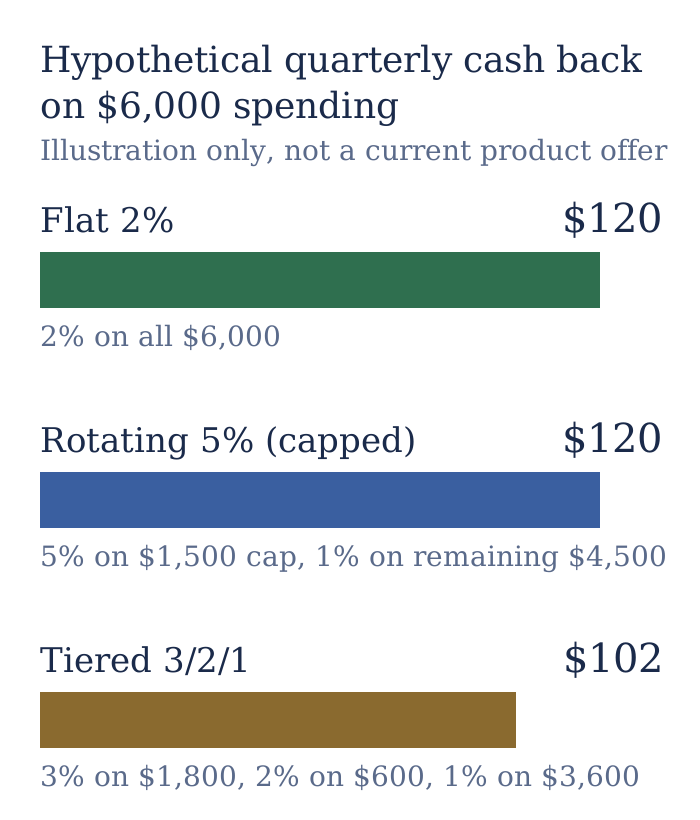
| Rotating 5%, capped at $1,500; 1% otherwise | $1,500 x 5% + $300 excess groceries x 1% + $4,200 other spending x 1% | $120 | 2.00% |
| Tiered: 3% groceries, 2% gas, 1% otherwise | $1,800 x 3% + $600 x 2% + $3,600 x 1% | $102 | 1.70% |
The rotating card ties the flat-rate card because the grocery cap limits its bonus earnings. The tiered card earns less because $1,200 of each month's spending receives only 1%. One quarter does not establish an annual winner: the rotating card's results change when its categories change.
Break-even reasoning: when category cards win or lose
For a card paying 5% in a bonus category and 1% elsewhere, let B equal spending that actually earns 5% after the cap, and T equal total eligible spending. Its rewards equal 1% x T + 4% x B, while a flat 2% card earns 2% x T. The rotating card wins when B exceeds 25% of T, ties at 25%, and loses below that share. In the example, $1,500 of $6,000 earns 5%, exactly 25%. With the same $1,500 cap, total quarterly spending above $6,000 would make the rotating card lose to flat 2%, even with the bonus allowance fully used.
For the illustrated tiered card, groceries earn one percentage point more than flat 2%, gas earns the same, and everything else earns one percentage point less. It wins when grocery spending exceeds spending receiving 1%. Here, $600 in monthly groceries is below $1,200 in monthly 1% spending, so it loses by $6 per month.
For pairing to improve this rewards-only comparison, route qualifying bonus purchases to the category card and other purchases to flat 2%. Other card benefits, such as travel or purchase protections, are outside this comparison. Pairing can increase rewards if the extra tracking works for you, and any additional annual fee must be smaller than the additional rewards.
Pitfalls that can reduce your return
These pitfalls are where category cards most often fall behind their advertised rates; run each one against any card you consider.
- Activation and caps: some rotating cards require enrollment each period and limit bonus earnings. For example, one major issuer pays 5% on up to $1,500 in category purchases each quarter only after activation. Check whether enrollment is required, the deadline, and whether the cap applies to spending or rewards.
- Merchant-category classification: issuers warn that a merchant that appears to fit a category may not carry that category's merchant code, in which case the purchase does not qualify. A store that looks like a supermarket might not code as one. Check how your issuer classifies merchants before counting on a category rate.
- Redemption rules: check your program's minimum redemption amount, available redemption methods, and their value before assuming a small balance is usable.
- Expirations and forfeiture: read rules covering expiration, inactivity, account closure, and loss of rewards. Programs do not all treat unused rewards the same way.
How to decide: a short checklist
Work through these checks in order; the first answer that clearly favors one structure usually settles the choice.
- Measure your normal spending. Review several months of purchases and account for seasonal expenses.
- Apply the actual rules. Include category definitions, activation, caps, fallback rates, and redemption restrictions.
- Calculate a full year. Estimate rotating categories conservatively; future categories may be unknown.
- Subtract costs. Compare rewards after annual fees. Interest can outweigh cash back; paying in full by the due date can avoid purchase interest when a grace period applies.
- Choose a manageable routine. Decide whether the additional rewards justify reminders, category tracking, or carrying multiple cards.
Takeaway
Choose flat-rate cash back when you value simplicity or much of your spending would earn a category card's lowest rate. Choose bonus categories when your existing purchases reliably qualify and the extra rewards survive caps, fees, and redemption rules. Calculate rewards in dollars across your whole budget, and avoid spending more simply to earn a higher percentage.
Sources and further reading
Sources checked October 29, 2026.
- CFPB Circular 2024-07: Design, marketing, and administration of credit card rewards programsCFPB Circular, December 18, 2024, checked October 27, 2026.
- CFPB: What is a grace period for a credit card?CFPB Ask page checked October 27, 2026.
- Discover 5% Cash Back CalendarDiscover page checked October 27, 2026.
- Provider education: Rewards category FAQProvider FAQ page checked October 27, 2026.