Compare reward dollars with interest dollars
A cash-back rate tells you what eligible purchases earn. A purchase APR expresses an annual interest rate. They describe different things: a reward is earned on qualifying spending, while interest on an interest-bearing balance depends on both the balance and time. Comparing 2% cash back with a 24% APR as though both applied once to the same amount misses that timing.
Before counting rewards as a saving, separate the purchase decision from the payment decision. Start with spending you already planned, estimate the rewards under your actual program rules, and subtract the interest and fees attributable to that spending. A higher earning rate does not make an unaffordable purchase affordable.
Check whether purchase interest applies at all
If your account offers a purchase grace period and you meet its conditions, paying the full balance by the due date can avoid purchase interest. Under those conditions, there is no purchase-interest charge to subtract from the reward on that spending. The CFPB defines the grace period as the time between the end of a billing cycle and the payment due date; it also notes that companies are not required to offer one, although most cards provide one for purchases.
If you lose the grace period by not paying your balance in full by the due date, the CFPB says you will be charged interest on the unpaid portion and on purchases in the new billing cycle starting on each purchase date. Do not assume that a purchase made after the last statement is interest-free until its next due date.
Paying only a minimum that is less than the full balance is not the same as meeting that full-payment condition. Before relying on interest-free time, check whether your purchase grace period is active. If you have lost it, ask the issuer what is required for it to apply again.
A $1,000 purchase earning $20, worked through
Assume one hypothetical $1,000 purchase earns 2% cash back, redeemable at full cash value: $1,000 × 0.02 = $20. Assume the full $1,000 is subject to interest from the purchase date at a fixed 24% APR. For this model only, define the daily rate as 0.24 ÷ 365. There are no other balances, payments, fees, new purchases or compounding during the illustrated period. These are invented terms for a calculation, not a card offer, a universal interest method or a payoff quote.
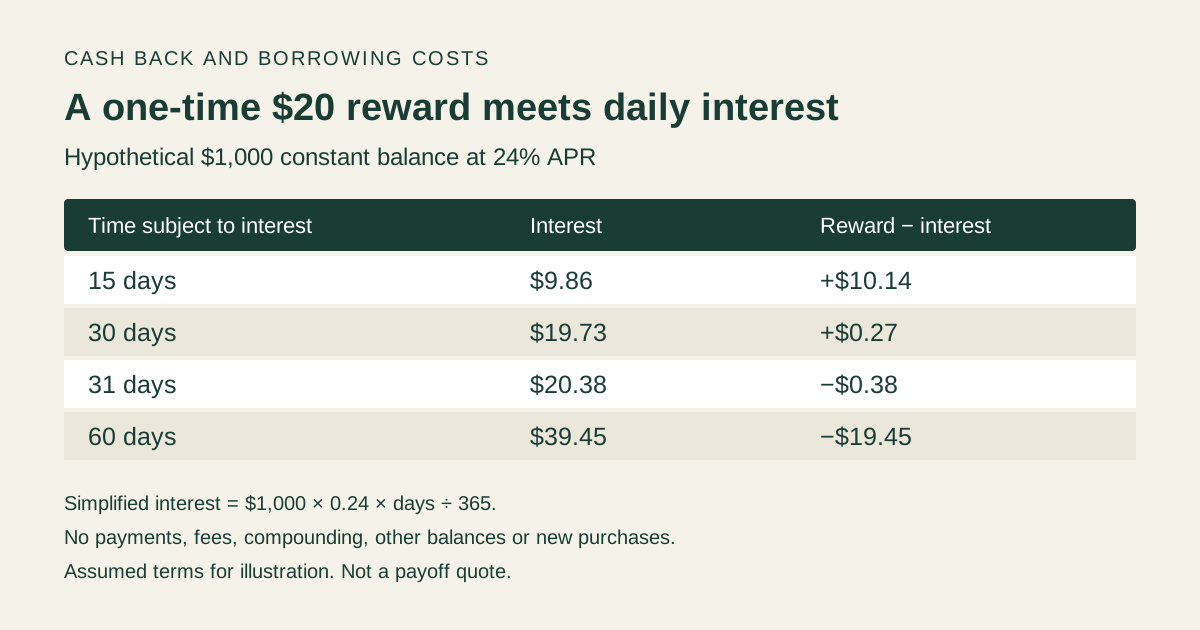
Under those assumptions, simplified interest is $1,000 × 0.24 × days ÷ 365. After 30 days, that is about $19.73, leaving only $0.27 of the $20 reward. After 31 days, interest is about $20.38, exceeding the reward by $0.38. After 60 days, interest is about $39.45, leaving a $19.45 cost after the reward.
In this example, the reward is earned once on the purchase, while the assumed interest continues for each day the principal remains outstanding. The reward that looked attractive at checkout is eventually overtaken by the modeled borrowing cost.
Scroll sideways to see every column.
| Days subject to interest | Simplified interest | Reward minus interest |
|---|---|---|
| 15 | $9.86 | +$10.14 |
| 30 | $19.73 | +$0.27 |
| 31 | $20.38 | −$0.38 |
| 60 | $39.45 | −$19.45 |
The break-even day is an illustration, not a deadline
With the same constant principal used for both reward and interest, divide the reward rate by the APR, then multiply by 365. Here, 0.02 ÷ 0.24 × 365 is about 30.42 days. In this simplified model, interest overtakes the reward on day 31. This threshold describes a cost comparison; it does not change your contractual payment due date.
The $1,000 cancels out of that formula only because the assumptions hold the same amount constant throughout. A reward earned on $1,000 of purchases cannot automatically be compared with interest on a different carried balance. Payments, additional transactions, fees, different rates or less-than-full redemption value change the comparison. Never use the illustrative threshold as permission to delay a required payment.
Real payments change the daily balances
The CFPB explains that many credit card companies calculate interest daily based on average daily account balances, and its guidance describes a daily periodic rate. An ending balance alone does not tell you what was owed on every earlier day. The next example illustrates that timing within the same simplified model; it does not reproduce any actual account calculation.
For a second simplified illustration at the same 24% APR, assume $1,000 is subject to interest for 15 days, then a payment reduces that principal to $500 for the next 15 days. With no compounding or other activity, interest is [($1,000 × 15) + ($500 × 15)] × 0.24 ÷ 365, or about $14.79. That is less than the $19.73 constant-balance illustration because less principal is outstanding during the second half.
The earlier $20 reward would exceed this simplified interest by $5.21, but $500 of purchase principal would still remain, plus any unpaid interest in the model. A positive reward-minus-interest figure does not mean the purchase has paid for itself or the principal has been repaid. If the assumed rate continues while a balance remains, further modeled interest can consume the remaining reward value.
Make the payment plan before chasing the rate
If paying in full is realistic and the purchase grace period is active, compare rewards on the spending you already intend to make. If you expect to carry a balance, estimate borrowing costs first. Keep the payment plan beside the reward rate so the comparison includes both.
If you already carry debt, distinguish interest on existing balances from the additional cost of new purchases. When a lost purchase grace period makes new purchases subject to interest, more spending can add to that interest-bearing balance. Consider pausing new purchases on that account while you check the repayment plan and ask about the grace period.
Regulation Z requires applicable periodic statements to disclose periodic rates with corresponding APRs, the balance subject to a periodic rate with an explanation of its calculation, and the date or period within which payment avoids additional finance charges. Use those disclosures to connect the rate, balance and payment timing. Ask the issuer to explain any calculation you cannot reconcile.
Keep redemption and payment separate, too. The provider guidance cited below says statement credits can reduce a card balance but generally do not count as a card payment; in most cases, a minimum payment is still required. Check what remains payable after a credit posts rather than assuming that requesting a reward redemption satisfies a payment obligation.
- Confirm whether your purchase grace period is currently active.
- Estimate rewards only on eligible spending you already planned, using the cash value you can actually redeem.
- Compare those rewards with interest over the expected repayment period, plus applicable fees.
- Keep required payments and due dates separate from any rewards calculation.
Sources and further reading
Sources checked October 29, 2026.
- CFPB: Credit-card interest rates and APRCFPB Ask page; checked October 29, 2026.
- CFPB: Purchase grace periodsCFPB Ask page; checked October 29, 2026.
- CFPB: How credit-card interest is calculatedCFPB Ask page; checked October 29, 2026.
- Provider education: How cash-back rewards workDated June 16, 2026; checked October 29, 2026.
- Regulation Z: Periodic-statement disclosures12 CFR 1026.7(b)(4), (5), and (8); checked October 29, 2026.
- Provider education: Statement credits and payment obligationsDated July 9, 2026; checked October 29, 2026.