Start with your own fuel budget
Review a few recent months of fuel spending. Separate regular driving from a one-time road trip so that an unusually expensive month does not become your annual estimate.
Write down the amount you expect to spend without changing your habits. Do not increase your driving, buy unnecessary items, or choose a more expensive purchase just to earn rewards. The goal is to evaluate spending already in your budget.
Next, match that budget to the actual rewards terms. A broad category label does not tell you whether a particular transaction qualifies. Programs can define eligible merchants and purchases differently.
Before counting a purchase, check:
- Which locations and types of fuel purchases qualify?
- Are there exclusions for fuel sold at a warehouse club, supermarket, or another retailer?
- Does paying inside the store, at the pump, or through an app affect eligibility?
- Are non-fuel items on the same receipt treated differently?
- Are there location restrictions or separate rules for electric-vehicle charging?
These are questions to resolve, not a statement that every program has those exclusions. If the written terms do not answer a question, ask the provider before including that spending in your estimate.
Read the limits before doing the math
Check whether there is a spending cap, when it resets, and what happens after you reach it. If several purchase categories share a cap, leave room for the other spending that counts toward the same limit.
Also check for enrollment or activation requirements, the period an earning rate applies, and the treatment of returned purchases. Do not assume that a reward rate applies indefinitely or that an uncompleted activation can be fixed after a purchase.
Keep a short record of the rules you are using. An estimate should identify its period, eligible spending, applicable rates, and any limit. Missing information is a reason to leave a result provisional, not to assume the most favorable treatment.
An illustrative calculation, including a cap
The following numbers are hypothetical teaching examples, not available offers or expected results. All amounts are in U.S. dollars.
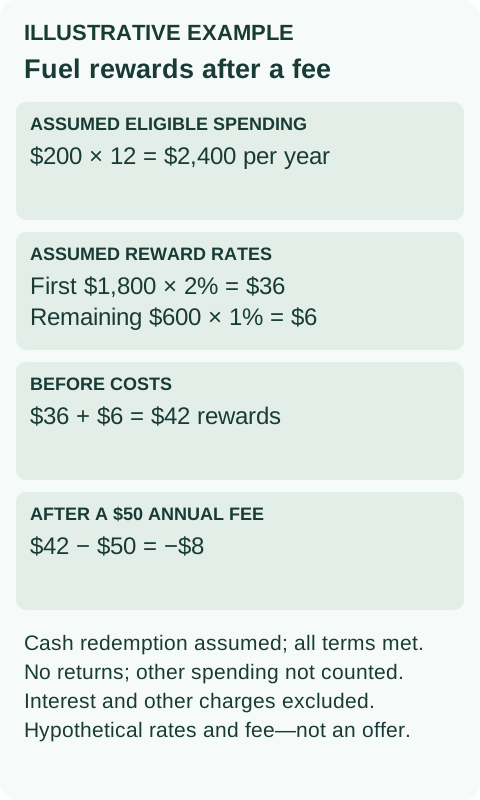
Suppose your existing fuel budget is $200 a month, or $2,400 a year. For this example only, assume all those purchases qualify, with 2% cash back on the first $1,800 of eligible annual spending and 1% on the remaining $600.
- First $1,800 multiplied by 2%: $36.
- Remaining $600 multiplied by 1%: $6.
- Total hypothetical rewards: $42 before costs.
If the account also had a hypothetical $50 annual fee, those fuel rewards alone would fall $8 short of that fee, before interest or other charges. This is not a comparison of real cards and is not a complete account valuation. Other eligible spending and benefits would require their own calculation, without counting the same value twice.
The example assumes the full reward amount can be redeemed as cash value, all conditions are met, and no purchases are returned. Different eligibility, redemption rules, or spending would change the result.
Make sure the rewards are usable
Find out how to redeem rewards, whether a minimum applies, and whether the redemption you want has the value you assumed. If rewards are expressed in points, do not treat the point total as a dollar amount.
Check expiration and account-status conditions before building rewards into a budget. Keep records of the relevant terms and your rewards activity. If a purchase earns less than expected, review the transaction and ask the provider for an explanation rather than assuming all later purchases will receive the higher rate.
Keep repayment ahead of rewards
A purchase grace period is conditional. When the account offers one and you meet its requirements, paying the full statement balance by the due date can avoid purchase interest. Carrying a balance can remove that benefit. Read your account's payment and grace-period terms.
If you expect to carry a balance, compare borrowing costs before focusing on rewards. Include the annual fee and other applicable charges in your budget. A reward estimate is not a promise of savings, and this guide does not predict whether you would qualify for an account.
Your next step
Write down your normal fuel budget, confirmed eligible purchases, any cap, the redemption method, and account costs. Then use the cash-back guide to understand the wider rewards structure. Review current terms and eligibility requirements before applying anywhere.
General education, not individualized financial advice.
Sources and further reading
Sources checked October 21, 2026.
- CFPB: What is a grace period for a credit card?Last reviewed September 23, 2024; reviewed October 21, 2026.
- CFPB: Credit Card Rewards Issue SpotlightMay 2024 report; reviewed October 21, 2026.
- CFPB: Consumer frustrations with credit card rewardsMay 9, 2024 release; archived; reviewed October 21, 2026.
- CFPB: Know Before You Owe — credit cardsUndated prototype guidance; page modified December 12, 2024; reviewed October 21, 2026.