What a prequalification result actually tells you
A prequalification message can feel like the difficult part is over, especially if you have been unsure whether an application is worth making. It is encouraging information, but it usually reflects an initial screening rather than a final lending decision. The useful question is what the provider has checked and what it still needs to decide.
Providers do not all use “prequalified” and “preapproved” in the same way. Some distinguish the terms; others use them interchangeably. A more confident sounding label is not a reliable way to compare two offers. Read the conditions attached to your own result, including whether a full application, further verification, or acceptance step remains.
For example, a result that invites you to apply is different from a screen showing an approved account that you can accept. Look for language explaining that the offer depends on additional information or continued eligibility. Do not assume a particular credit limit, final interest rate, or approval probability unless the provider explicitly states it for you.
Find out when the credit check changes
A soft credit inquiry does not affect your credit scores. Many eligibility checks use this type of inquiry. A hard inquiry, commonly associated with a credit application, can affect them. The fact that the first screen says your score will not be affected does not automatically describe every later step.
Before continuing, read the explanation beside the next button and any credit-report authorization. Some providers describe the change at application; others explain it at acceptance. If you cannot tell which action triggers a hard inquiry, ask through the provider’s official support channel before proceeding. A marketing headline is less useful here than the specific consent language.
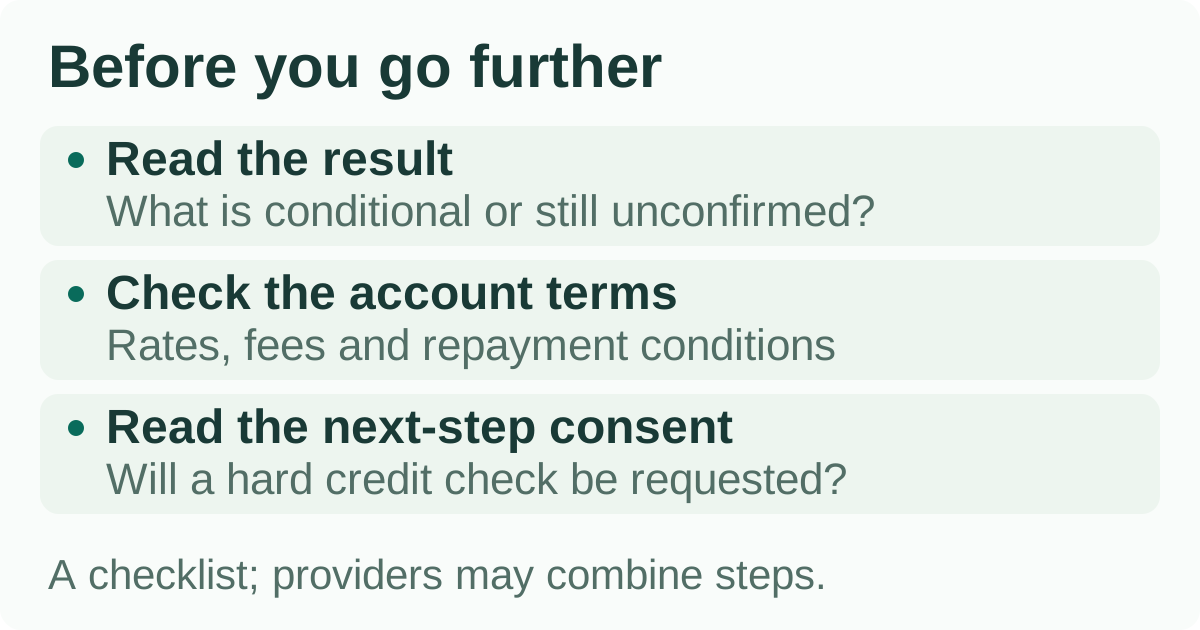
Imagine you checked eligibility while comparing options yesterday. Today the provider asks you to confirm information and submit an application. Treat that as a new decision point: reread the inquiry explanation rather than relying on yesterday’s promise. Keep a copy of the information you are agreeing to so you can distinguish the screening from the application later.
Read the cost of the account you would actually open
Prequalification answers a lending question. It does not answer whether the account is affordable for you. Find the rates and fees disclosure associated with the application and compare it with the result you received. If the terms show a range, do not build your budget around the lowest end as though it were already your assigned rate.
- Annual or other recurring fees: how much is charged, when, and whether a waiver ends.
- Purchase APR: the annualized interest rate for purchases, including what applies after any introductory period.
- Different transaction rates and fees: a purchase promotion may not cover a transfer or cash advance.
- Purchase grace period: the conditions for avoiding purchase interest and what happens if you carry a balance.
- Any deposit or opening requirement: the amount, when it is needed, and the written return conditions.
A temporary benefit deserves its own plan. Write down its end date and the cost afterward, then ask whether you would still want the account once the benefit finishes. This prevents an attractive opening offer from becoming the only reason for a long-term commitment. Save the actual terms, not just the promotional summary.
Try the payment plan before the application
Start with a purchase you already expect to make and the money that would repay it. A card can change when you pay; it does not create extra income. If the only plan is to find money after the statement arrives, being eligible for the account has not solved the underlying problem.
Suppose you intend to put $120 of routine monthly spending on the card and your budget already reserves $120 for it. Moving that purchase to a card can fit the same spending plan. If you have only $70 available to repay it, you start with a $50 shortfall before any interest or fees. A larger credit limit would not eliminate that gap.
Also account for opening costs separately. A hypothetical $200 deposit plus that $120 purchase would require $320 of available cash to fund both, even if the deposit may eventually be returned. Do not count the same dollars twice. Keep rent, food, existing bills, and a practical cash cushion in the picture rather than spending the cushion to qualify.
Use the result to narrow your choices
Give the card one clear job: paying routine spending in full, establishing your own payment record, or financing a defined expense under terms you understand. Then compare the feature that matters for that job. A high rewards headline tells you little about affordability if you expect to carry a balance.
For a first routine-spending account, a comparison sheet might contain three lines: unavoidable yearly cost, money needed to open it, and how you will make payments. Put two realistic options beside each other using those same lines. Leave unknown terms marked unknown. A missing answer is a reason to investigate, not an invitation to substitute the most optimistic number.
You do not need to turn every eligibility result into an application. It can be useful simply to learn that an option exists and decide it does not fit. If none matches your budget or purpose, waiting while you improve the payment plan is a complete decision; you have not failed to use an offer.
Check the last screen before you continue
Make sure you can describe the next action in ordinary words: checking eligibility, applying for credit, or accepting an account. Confirm that the information you entered is accurate and follow the provider’s instructions for what belongs in each field. If a field is unclear, seek clarification rather than choosing an answer intended to improve your chances.
- Do I understand whether this step can cause a hard inquiry?
- Have I read the conditions and costs for this application, including any terms that are still undecided?
- Can I explain what I will use the account for and where the payment money will come from?
- Have I saved the result and terms so I can check what happens next?
Complete any application through the provider’s verified process. If a message arrives unexpectedly, navigate to the official site or use a known contact method instead of trusting the message alone. Card Tomorrow explains decisions and comparisons; it does not collect your credit-card application or make the approval decision.
Choose an account you can manage
Proceed when the account serves a useful purpose, the costs make sense, and the application step is clear. Pause if the offer depends on a payment plan you cannot yet support or a term you cannot explain. The right outcome is an informed choice, whether that means applying, comparing another option, or leaving the decision for later.
If you do apply, save the confirmation and read the actual result. An application still under review needs a different response from an approval or a denial. For an approved account, check the assigned terms and set up a payment routine before using it. The initial eligibility message is the beginning of that decision, not the whole decision.
Sources and further reading
Sources checked September 17, 2026.
- Provider education: preliminary eligibility and final approvalNo publication date displayed; checked September 17, 2026.
- Provider education: prequalification, preapproval and inquiry typesSource dated August 11, 2026.
- Consumer guidance: credit-report inquiriesSource reviewed September 24, 2024.
- Consumer credit regulation: application rates and fee disclosuresCurrent regulation inspected September 17, 2026.
- Consumer guidance: purchase grace periods and paying in fullSource reviewed September 23, 2024.