Start with the statement balance and its due date
Your first bill may show one balance while the account screen shows another. That usually reflects activity after the statement closed. Before paying, identify the statement balance and the payment due date printed beside it.
The statement balance is the amount recorded at the end of that billing cycle. The current balance changes as later activity posts. The minimum payment is the amount required for that bill; paying it can still leave you owing interest.
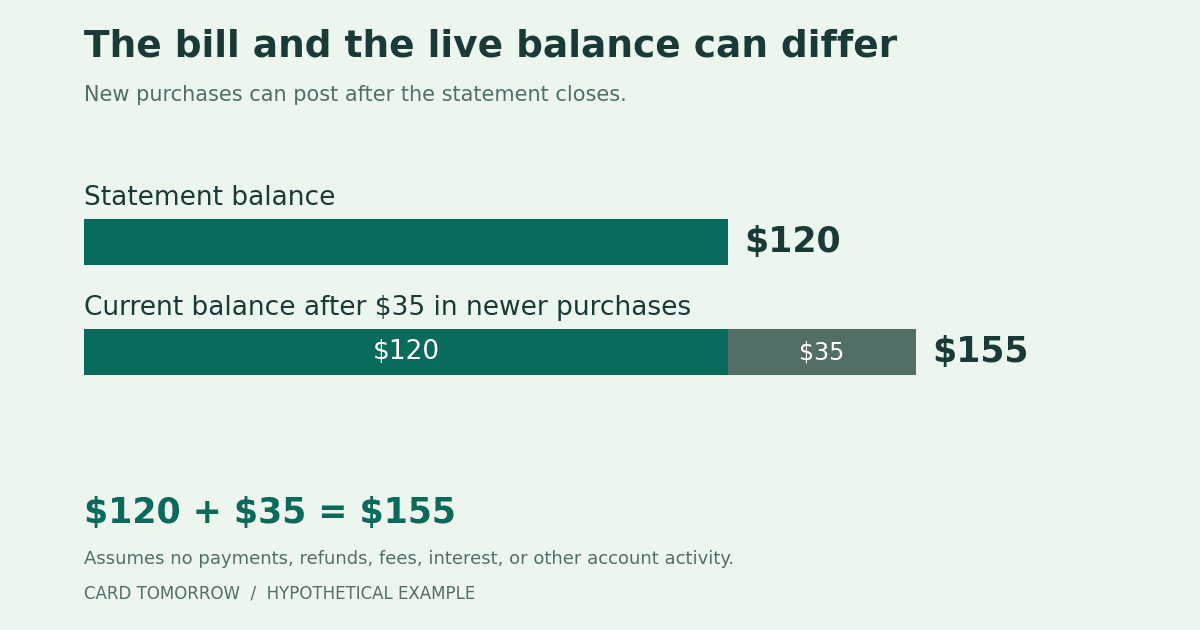
A $120 bill can sit beside a $155 current balance
Imagine your statement closes at $120. You then make $35 of new purchases, with no other activity. Your current balance becomes $155, but those later purchases do not change the $120 balance on the statement that already closed.
If your account has an active purchase grace period, you meet its conditions, and these are ordinary purchases, paying the $120 statement balance in full by its due date generally avoids interest on that statement’s purchases. Budget for the newer $35 too; it has not become free spending simply because it falls in the next cycle.
| Figure | Example | What it tells you |
|---|---|---|
| Statement balance | $120 | The balance when the last billing cycle closed |
| Newer purchases | $35 | Spending added after that statement closed |
| Current balance | $155 | The total now, before any payment or other activity |
The minimum is a fallback, not your spending budget
Suppose the same statement required a $25 minimum payment. That is an invented amount for this example, not a rule for student cards. Paying $25 would leave $95 of the $120 statement balance unpaid, before considering the newer purchases or any subsequent charges.
A minimum payment can keep you from missing the bill while you work through a tight month. It does not promise an interest-free balance. If paying the statement in full is becoming difficult, reduce new charges and contact the issuer before the due date to discuss available help.
Make the first month easy to repeat
Choose a small set of purchases already covered by your budget. Leave the corresponding money available for the bill. A $1,000 credit limit is permission to borrow up to a limit under the agreement; it is not another $1,000 of income.
Use a reminder or automatic payment to reduce the chance of forgetting the due date. If you choose automatic payment, confirm the selected amount and start date, then check that it actually goes through. Keep enough money in the payment account. Automation helps with remembering; it cannot supply missing funds.
You can build a history without paying interest
Consistent on-time payments and modest balances relative to your available credit are useful habits. Carrying debt from one month to the next is not a requirement for building credit. There is no need to manufacture an interest charge to prove you can borrow.
Avoid opening several accounts simply to chase a score. First make one account easy to manage, and check your credit reports for errors. A student label does not guarantee approval or a particular credit-score result.
Choose for the routine you will actually keep
For a first card, clear payment terms and affordable account costs deserve more attention than a complicated reward schedule. Compare the student category if you meet its eligibility requirements. If that route does not fit, review the building-credit category and focus on the account terms you can manage comfortably.
Sources & further reading Checked September 15, 2026
- Statement balances, minimums, and payment informationSource dated February 26, 2026.
- CFPB: when purchase grace periods applyFoundational reference; reviewed September 23, 2024.
- CFPB: payment habits and building a credit historyFoundational reference; reviewed December 12, 2024.
- Payment reminders, automatic payments, and budgetingSource dated March 19, 2026.