Redemption terms shape what you receive
Cash-back rewards are useful when you can redeem them on acceptable terms. Your redemption method, the minimum required, and the rules for keeping rewards can affect what you receive.
Start with your card's rewards agreement. Check which methods are available and how much value each delivers. A balance displayed in dollars does not establish that every redemption option provides equal purchasing power.
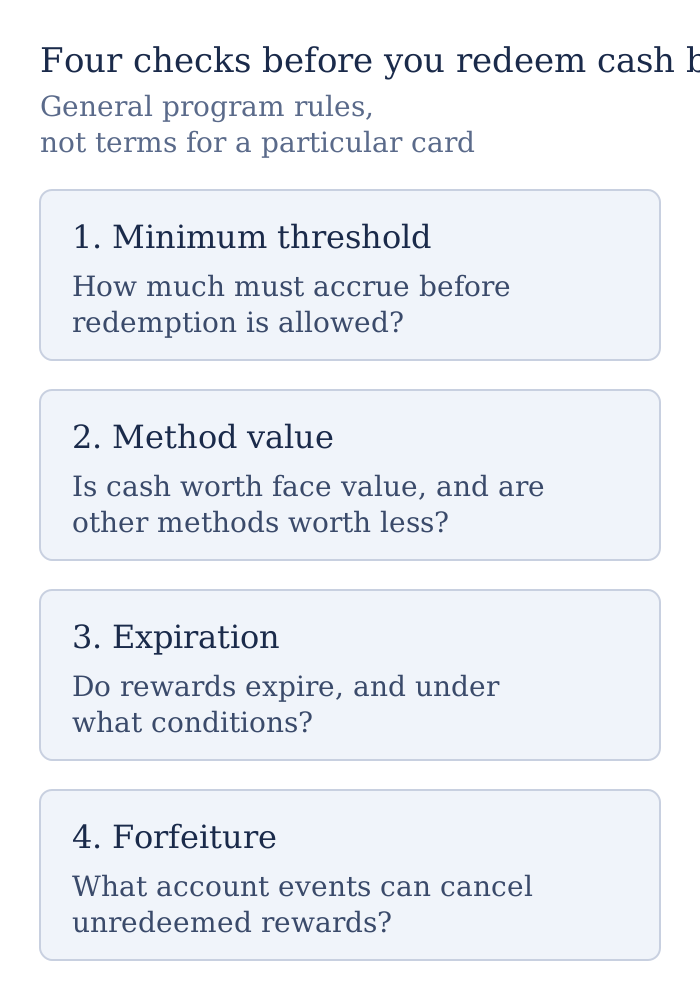
Compare redemption methods
Face value means receiving $1 of cash or purchasing power for each $1 of cash-back rewards redeemed. If your program tracks rewards as points, check the conversion rate for each method.
Use these questions to compare your program's options:
Scroll sideways to see every column.
| Method | Value comparison to make | Rules and restrictions to check |
|---|---|---|
| Statement credit | How much will your card balance decrease for the rewards surrendered? | Is there a minimum? When will the credit post? What payment remains due? |
| Direct deposit | How much money will reach your bank account for the rewards surrendered? | Which accounts qualify? Is verification required? Are there minimums or fees? |
| Check | What is the check amount compared with the rewards surrendered? | Is there a minimum or fee? How long does delivery take? Is there a deposit deadline? |
| Gift cards | What is the card's face amount compared with its rewards cost? | Which denominations and retailers are available? What restrictions or fees apply? |
| Merchandise | What would you otherwise pay for the same item compared with the rewards required? | Are shipping and taxes included? What return restrictions apply? |
| Travel portals | What would the same booking cost elsewhere compared with the rewards required? | Are the itinerary, cancellation terms, taxes, and fees equivalent? What booking restrictions apply? |
For merchandise and travel, use the price you would actually pay for an equivalent purchase. A catalog's stated retail price alone does not establish value.
For gift cards, consider whether the redemption replaces a planned purchase. Even a favorable conversion provides little practical benefit if you leave the card unused.
A statement credit also requires special care. One large issuer states that a statement credit is not a payment and does not count as a minimum payment. If a balance remains, a minimum payment is still due. If the statement credit equals the outstanding balance, the issuer explains that the balance becomes $0 once applied. Check your actual remaining minimum and due date; don't assume a requested or pending credit counts as payment.
Understand minimums and stranded balances
A redemption minimum is the smallest amount your program allows you to redeem through a particular method. Check each option separately rather than assuming one threshold applies to everything.
Also distinguish a minimum from an increment. A hypothetical $25 minimum could allow a $47.50 redemption. A rule requiring $25 increments would permit only $25, $50, and other specified amounts.
A small balance can therefore remain unusable through your preferred method. If you stop earning rewards before reaching the threshold, the remainder may stay stranded. Check whether another permitted method allows a smaller redemption.
Program rules differ. One issuer's rewards page describes redemption of any or all available rewards while an account is open and in good standing, along with automatic redemption options. The limited provider page containing Q1 2024 material cited below describes different requirements for cash and gift-card redemptions, but its content has important scope and migration limitations.
Avoid unnecessary spending just to cross a redemption threshold. Unlocking rewards does not make an otherwise unwanted purchase worthwhile.
Worked example: what happens to $47.50?
Assume you have $47.50 in available cash-back rewards, cash redemptions require at least $25 per transaction, and amounts above that minimum are flexible. There are no redemption fees.
Redeem $25 now: You receive $25 and leave $22.50 in rewards. You cannot make a second $25 redemption yet. After earning another $2.50, you can redeem $25 again. Across both transactions, you receive $50: your original $47.50 plus $2.50 earned later.
Redeem the full balance now: Under these assumed flexible-amount rules, you could redeem all $47.50 in one transaction.
Wait: After another $2.50 posts, you could redeem $50 once. That produces the same nominal total as two $25 redemptions. Waiting does not itself increase the value of the original rewards; it delays access. Do not make extra purchases solely to earn that additional $2.50.
If the hypothetical program instead requires $25 increments, you could redeem only $25 from the original balance, leaving $22.50 until more rewards arrive.
Now consider a separate hypothetical program offering gift-card-only redemption, where a $25 gift card costs $30 in rewards. This is not Discover's pricing. From $47.50, you could obtain one $25 gift card and retain $17.50 in unredeemed rewards.
The redeemed portion delivers $25 ÷ $30, or about 83 cents of purchasing power per reward dollar. You receive $5 less than the face value of the rewards surrendered. The remaining $17.50 is unredeemed rewards - not cash and not a loss - but it is below the amount required for another card in this example. The gift card's practical value also depends on whether you can use it for planned purchases.
These figures illustrate hypothetical rules, not terms for a particular card.
Check expiration, inactivity, forfeiture, and closure separately
Expiration: Does your agreement give rewards an expiration date? If it says rewards do not expire, what conditions apply? One issuer's rewards page describes no expiration for the life of the account, alongside potential loss of unredeemed cash back upon closure.
Inactivity: Does the agreement impose an activity requirement? What counts as qualifying activity? Does logging in or redeeming rewards count, and can inactivity lead to account closure? Look for explicit answers rather than assuming any account interaction resets a deadline.
Forfeiture and eligibility: Does delinquency, default, suspected misuse, or another specified event restrict redemption or cause forfeiture? What does "good standing" mean under your agreement? One issuer identifies an open account in good standing as a redemption requirement and describes rewards as earned on net purchases - purchases minus credits or returns.
Account closure: What happens if you close the account or the issuer closes it? Is there an automatic payout, a redemption window, or forfeiture? Does a minimum still apply? Before requesting closure, confirm the applicable rules, redeem eligible rewards, and check that the redemption has completed.
The cited limited provider page contains Q1 2024 content and covers a limited set of redemption rules. It also cautions that cards migrated to a different issuer's systems may have different benefits and features. Treat it as a limited reference, not current universal terms for that program's cards; check the agreement and account information that apply to your card.
Avoid these redemption pitfalls
Each of these pitfalls quietly reduces what your rewards are worth; check each one against your card's terms before you redeem.
- Accepting less than face value: Compare the cash or realistic purchasing power received with the rewards surrendered.
- Leaving small balances stranded: Check whether a remainder will fall below your preferred method's minimum.
- Assuming rewards survive closure: Confirm the applicable payout, redemption-window, or forfeiture provisions before closing an account.
- Treating a statement credit as a payment: A statement credit does not replace a required minimum payment. Check what remains due after a credit posts; the issuer's zero-balance explanation applies only once the balance actually reaches $0.
- Choosing restricted value you will not use: Gift cards, merchandise, and travel redemptions should replace purchases you already planned.
Set your redemption routine
A short routine keeps the rules working for you instead of against you. Set it up once, then it takes a moment each statement.
- Record the rules: Note each available method's minimum, increments, conversion rate, fees, and processing time.
- Choose a default: Select a useful method that delivers acceptable value.
- Review monthly: Check available rewards alongside your statement. If automatic redemption is offered, review its options and thresholds before enabling it.
- Check before setting a card aside or closing it: Review small balances, activity requirements, redemption eligibility, and closure provisions.
Sources and further reading
Sources checked October 29, 2026.
- Provider education: Cashback Bonus redemption rules (limited reference; contains Q1 2024 content; cards migrated to another issuer's systems may differ)Publication/update date not displayed; checked October 27, 2026.
- Provider education: Rewards (redemption amounts, eligibility, automatic redemption, net purchases, potential loss on closure)Publication/update date not displayed; checked October 27, 2026.
- Provider education: Credit card benefits (footnote 4 states a statement credit is not a minimum payment)Publication/update date not displayed; checked October 27, 2026.
- Provider education: Statement credits, remaining payment obligations, and the zero-balance explanationDated July 9, 2026; checked October 27, 2026.