Separate the fee from the time you borrow
Taking cash from a credit card borrows against the card account. A transaction fee can apply, an ATM may charge separately, and interest commonly starts when you withdraw the money.
Paying sooner can reduce the interest. It does not mean the transaction fee disappears. Cash-advance terms can also differ from purchase terms, including the interest rate and the amount you can withdraw.
A $300 example starts with $18 in charges
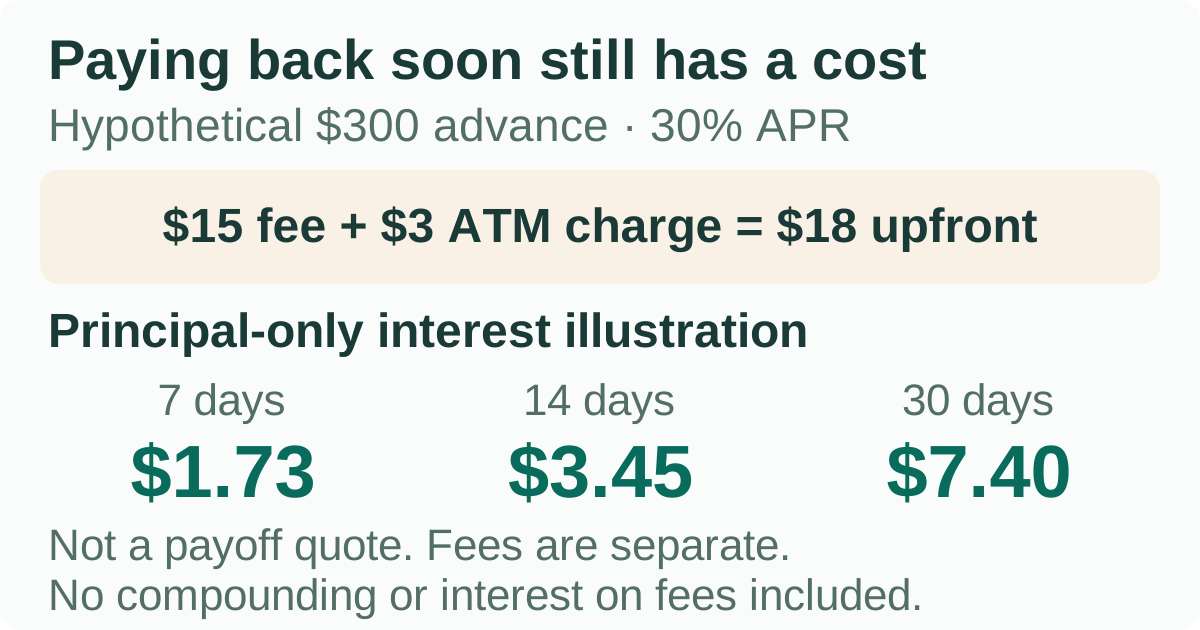
Imagine a $300 withdrawal with a transaction fee equal to the greater of $15 or 5%, plus a $3 ATM charge. These are hypothetical terms.
Five percent of $300 is $15, so the transaction fee is $15. Add the $3 ATM charge and the upfront cost is $18, before interest. That is 6% of the cash received, even if you plan to repay soon.
Then consider the interest while the balance remains
For a simple illustration, assume the $300 principal stays unchanged and the cash-advance APR is 30%. Using a 365-day year, multiply $300 by 0.30 and by the number of days, then divide by 365.
Scroll sideways to see every column.
| Borrowing period | Illustrative interest, rounded |
|---|---|
| 7 days | $1.73 |
| 14 days | $3.45 |
| 30 days | $7.40 |
This illustration excludes compounding, interest on fees, intervening payments and other account activity. Your agreement's calculation method and payment timing can change the actual charge. The table is not an exact payoff amount; ask the provider for the amount needed to clear your balance.
Read these terms before withdrawing
- The transaction fee, including any minimum dollar amount.
- The cash-advance APR and when interest starts.
- Any separate ATM charge.
- Your available cash-advance limit, which may be lower than the overall credit limit.
- How your payment will be applied if the account has several types of balance.
Some transactions other than ATM withdrawals can also count as cash advances. Check how the provider treats the specific transaction before relying on purchase terms or a promotional rate.
Compare the full cost with the need
In the example, the $18 upfront charge matters more than the first week's illustrated interest. Compare the total cost and a realistic repayment plan before borrowing. If the purpose is to meet another bill, first ask whether its provider offers a payment arrangement and compare those terms too.
Sources and further reading
Sources checked September 17, 2026.
- Consumer guidance: cash-advance limits, fees and interestSource reviewed September 2, 2026.
- Consumer guidance: daily interest and payment allocationSource reviewed January 22, 2024.
- Provider help: cash-advance costs and transaction typesNo publication date displayed; checked September 17, 2026.