Find out what happens if you finish late
Before using a promotional offer for a large purchase, ask one question: what would I owe if a small balance remained when the promotion ended? The answer tells you whether you are looking at 0% APR or deferred interest.
With a true 0% APR promotion, eligible balances carry no interest during the stated period. When it ends, the ongoing rate generally starts applying to the amount still owed. Deferred interest works differently: interest builds during the promotion and can be charged back to the purchase date if you do not satisfy the full-payoff condition.
Read the sentence after “no interest”
An offer described as no interest if paid in full by a deadline commonly signals deferred interest. That condition changes the cost of falling short. Confirm the actual financing terms before agreeing to the purchase; the large type on a checkout screen may not tell the whole story.
Both arrangements can require monthly payments. An interest promotion does not give you permission to skip a bill. Fees and payment requirements are separate from the advertised rate.
| Question | True 0% APR | Deferred interest |
|---|---|---|
| Interest during the promotional period | 0% on covered balances | Accrues, with charges deferred |
| Balance remains when the period ends | Ongoing interest starts on the remaining balance | Accrued interest can be added under the offer’s terms |
| Minimum payments still required | Yes | Yes |
A $2,400 purchase needs a complete payment plan
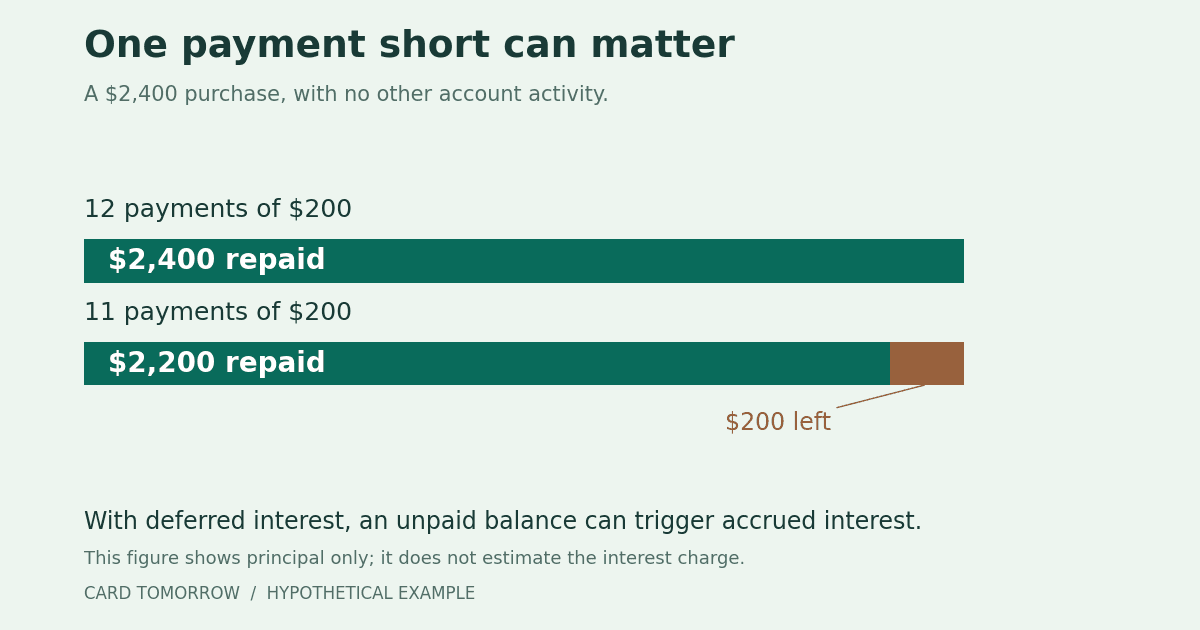
Imagine a $2,400 purchase, no fees or other activity, and twelve available payment dates before the promotion ends. Twelve payments of $200 repay the purchase in full. Eleven leave $200 of principal unpaid.
Under a true 0% promotion that remains in effect through its scheduled end, that $200 does not trigger interest for the earlier promotional months. Under deferred interest, it can trigger the accrued charges on the promotional purchase. The exact charge depends on the agreement, the rate, daily balances, and when payments were credited; it cannot be calculated from the final $200 alone.
Choose a payoff date with room to spare
Use the promotion’s exact expiration date, which may differ from your regular payment due date. Plan to finish earlier. In the same $2,400 example, ten payments of $240 would finish the principal two planned payments sooner than twelve payments of $200.
That earlier target gives you time to correct a failed payment or confirm a remaining balance. Keep required minimums covered in every billing period, and check that extra payments actually reduce the promotional balance when the account has other balances.
Compare the offer against the purchase you already planned
Write down the cash price, any account or transaction fees, the covered purchases, and the payment that clears the debt before your target date. A financing offer should help you pay for a purchase already in the budget. It should not turn a manageable purchase into a larger one.
If the payment leaves too little room for ordinary expenses, a longer headline promotion does not fix that problem by itself. Reconsider the price or timing of the purchase. For a workable plan, compare introductory-APR terms and check the ongoing rate before choosing an account.
Sources & further reading Checked September 15, 2026
- CFPB: zero-interest and deferred-interest promotionsFoundational article published June 8, 2017; page modified June 25, 2026.
- How a 0% APR promotion worksSource dated April 7, 2026.
- Introductory periods, covered transactions, and paymentsSource dated August 18, 2026.
- CFPB: deferred-interest deadlines and payment allocationFoundational reference; reviewed January 22, 2024.