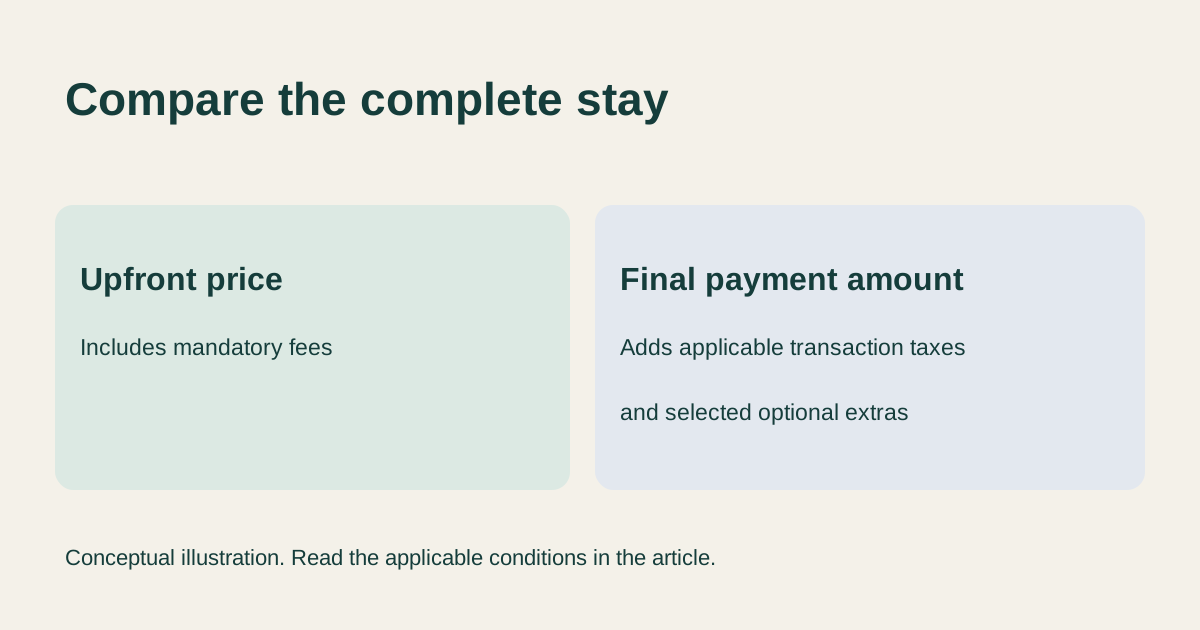
A hotel price can include its mandatory fees and still leave something to add before payment. The distinction is between the cost of booking the advertised stay and the final bill for the stay you select, including government taxes and optional purchases.
The Federal Trade Commission's hotel-pricing rule, effective May 12, 2025, did not abolish resort fees or put a ceiling on them. It changed how covered prices must be presented. A required resort or cleaning charge belongs in the upfront comparison; a genuine extra need not be included before you choose it. The FTC describes the rule as a transparency requirement, not a ban on particular fees or pricing strategies.
A mandatory fee is part of the price
A required resort charge or cleaning fee is not a separate purchase simply because the hotel gives it a separate name. It must be included in the displayed total. The hotel may still itemize the charge, but the lower room rate cannot overshadow the total that includes it. The regulation requires that total to be more prominent than other pricing information, except the final payment amount.
Optional also means more than removable. In its staff guidance, the FTC says an automatic fee waived only after a guest notices and challenges it is mandatory. Pre-checked boxes and opt-out billing do not turn a required charge into a genuine choice. By contrast, a trip-protection plan a guest affirmatively selects can be optional.
These requirements cover booking intermediaries as well as lodging businesses. Comparing a hotel's website with a third-party booking platform does not change the basic distinction between a required payment and an optional purchase.
Two nights, two different winners
Consider a hypothetical two-night stay for one room, with identical dates and occupancy. There are no discounts, payment surcharges or mandatory charges beyond those listed. Property A includes parking; Property B offers genuinely optional parking for $20 a night. For simplicity, a 10% government tax applies to every amount, including parking. That is an illustrative assumption, not any jurisdiction's actual tax treatment.
Property A has a $160 nightly base rate and a mandatory $30 nightly fee. Across two nights, its mandatory-price total is $380: two times $190.
Property B has a $175 nightly base rate and a mandatory $20 charge per stay. Its corresponding total is $370: two nights at $175, plus $20 once.
Those $160 and $175 base rates explain the arithmetic. They would not be appropriate stand-alone headline prices for these bookings. The two-night comparison must include the mandatory charges: $380 for A against $370 for B, before the permitted exclusions.
Without purchased parking, A costs $418 after $38 in tax. B costs $407 after $37 in tax. B is $11 cheaper, despite having the higher base nightly rate. The smaller-looking nightly price pointed toward the more expensive stay.
Now select parking at B. Two nights of parking add $40, taking the taxable amount to $410. With $41 in tax, B's final price is $451. A remains $418, making A $33 cheaper.
The ranking changed twice, for different reasons. Mandatory fees exposed the weakness of comparing base rates alone. Parking then changed what the traveler was buying. For a guest who does not buy parking, B retains its advantage in this example; for one who does, A costs less. The increase from selected parking is not, by itself, evidence of a hidden mandatory charge.
A fee-free payment option must be usable here
Payment fees can fall on either side of the same boundary. If card payment is required, its surcharge is mandatory and belongs in the upfront total. If a viable fee-free method is available at the same location or platform, the charge for choosing another method can be excluded initially, according to the FTC staff FAQ.
The location matters. A fee-free option somewhere else does not necessarily make a surcharge optional in the transaction on your screen. The FTC's explanation of the final rule gives the example of an online ticket purchase: an in-person cash option does not replace a fee-free online option. The principle concerns the offered transaction, not every way a business might accept money.
For hotel comparisons, that means the payment method is part of the price question. A genuinely optional surcharge still enters the final amount if that method is selected. And the disclosure rule does not authorize a surcharge that another law prohibits.
What belongs in the final amount
Government charges imposed on the booking transaction may be excluded from the upfront total. That does not include an allocated share of the hotel's own property or income taxes merely relabeled as tax recovery. The final rule's explanation distinguishes transaction taxes from those business expenses.
As choices supply the information needed to calculate applicable charges, the price must be updated. Before the guest is required to pay cash or provide payment information, the seller must disclose excluded charges, their amounts and what they are for, along with the final payment amount. That final figure must be at least as prominent as the upfront total. The rule's disclosure requirements do not permit a known required resort fee to be saved for the last screen.
Price transparency is separate from cancellation flexibility. The rule prohibits misrepresenting a fee's refundability; it does not make every booking refundable. A clearly displayed total can still accompany restrictive cancellation terms.
The useful comparison is therefore a complete stay with the choices that matter to the traveler. In the example, the parking decision is enough to change the winner. Mandatory fees should already be accounted for when comparing the advertised offers. Taxes, selected extras and the chosen payment method then determine the amount payable. A low base rate and a lower completed-booking total are not the same thing.
Sources and further reading
Sources checked October 22, 2026.
- FTC describes the ruleMay 2025; effective May 12, 2025.
- regulationCurrent regulation; reviewed October 22, 2026.
- staff guidanceStaff guidance; reviewed October 22, 2026.
- FTC's explanation of the final ruleJanuary 10, 2025.