The Department of Transportation has postponed a change in how airlines report the causes of delays and cancellations. Its October 15 notice moves the rule's effective date from October 19, 2026, to February 1, 2027.
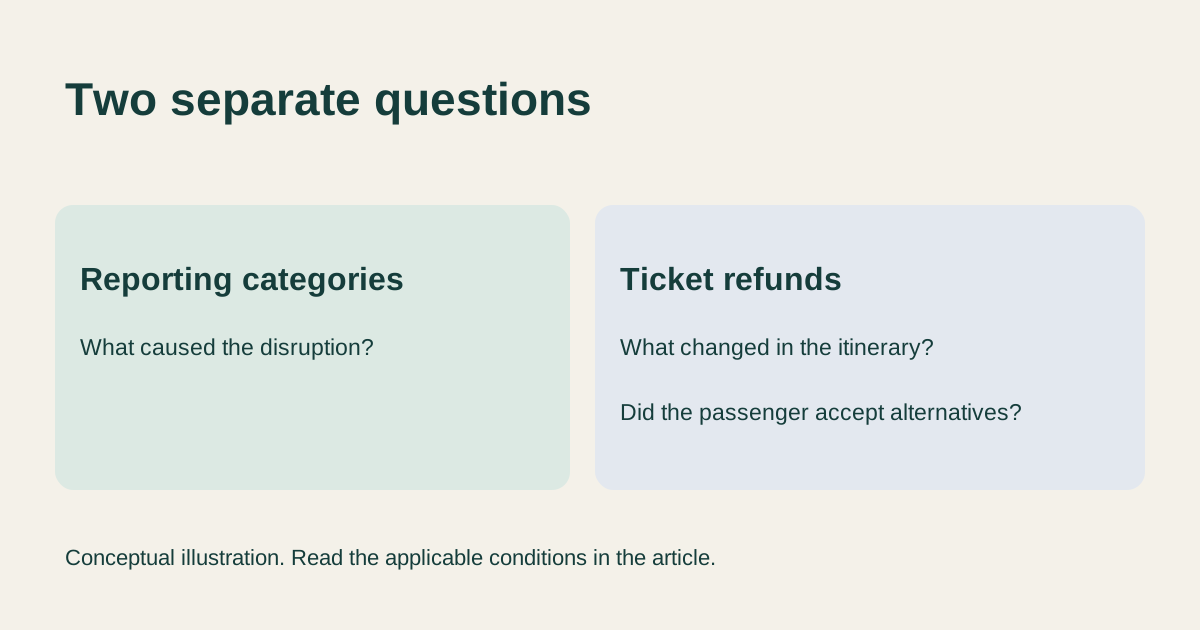
That is not a postponement of airline ticket refunds. Whether an airline must return unused airfare depends on what happened to the itinerary and whether the passenger accepts replacement travel or compensation instead. Who controlled the disruption is not the refund test.
The distinction matters because the reporting change could affect another kind of help: amenities and compensation promised for disruptions within an airline's control.
Why February's rule covers January flights
The first affected flights will occur in January, not February. Airlines submit their delay-and-cancellation reports monthly, within 15 days after the month ends. The February effective date therefore applies to reports covering flights from January 1, 2027, onward.
DOT agreed to the postponement to allow more time for reporting instructions, airline and government computer-system changes, and approval of the revised information collection. Starting with a new calendar year should also make the reporting transition clearer, the department said. The notice specifies that the entire January reporting month must use the revised categories.
A different label does not shorten a delay
The underlying September 3 rule creates a category called Section 511(b) for ten causes that Congress excluded from the Air Carrier category. It does not expand which airlines or flights must report.
The exclusions include removing an unruly passenger and a baggage-loading delay caused by an outage of a bag system controlled by neither the airline nor its contractor. That last condition matters: the exclusion does not cover every baggage-system problem.
Under BTS's 2026 reporting instructions, airlines report causal data for cancellations and flights arriving at least 15 minutes late. That threshold determines which delays need an explanation in the statistics. It does not establish a passenger's right to a ticket refund.
Moving a disruption between categories leaves its actual arrival time unchanged. A future fall in the Air Carrier category, taken alone, would therefore not demonstrate better punctuality. Comparisons across the transition will need to account for the changed definitions.
The refund turns on the itinerary and the passenger's choice
For covered scheduled flights to, from or within the United States, DOT's refund rule covers cancellations and qualifying significant changes or delays. It includes nonrefundable tickets when the passenger declines the changed or replacement travel and compensation offered instead of a refund.
Consider a hypothetical cancellation. Two passengers bought nonrefundable, one-way domestic tickets directly from the same airline, which processed their payments. One accepts a replacement flight and takes it. The other rejects replacement travel and the voucher offered in place of a refund.
On those facts, the second passenger meets the rule's refund conditions. The first, having accepted and taken the replacement, does not get a full fare refund simply because the original flight was canceled. The disruption's cause is identical; their choices differ. DOT's consumer guidance makes that distinction explicit. An airline can offer a voucher instead, but it must tell an eligible passenger about the right to a refund.
For timing changes, the regulatory thresholds are a scheduled arrival at least three hours later for a domestic itinerary or six hours later internationally. A departure moved that much earlier also qualifies. Different origin or destination airports, added connections, downgrades and specified disability-related changes can qualify, too.
Those are itinerary-change criteria, not a requirement to spend three or six hours waiting at the airport. A cancellation is a separate trigger. And a delayed departure, by itself, is not the same measurement as the scheduled-arrival change in the rule.
Meals and hotel rooms are a separate question
A ticket refund returns money for travel the passenger does not take. Meals, hotel rooms and other disruption assistance address the consequences of a disrupted trip. A passenger who continues traveling may still qualify for a promised amenity, depending on the airline's service plan and the circumstances. DOT's cancellation and delay dashboard distinguishes those commitments from refund rights.
This is where the new classification could have a consumer consequence. In its September rule's economic analysis, DOT predicts a reduction in the total value of amenities and compensation provided to passengers as the ten causes leave the Air Carrier category. The department says it cannot reliably estimate the size of that reduction.
That is a forecast, not a measured loss or a declaration that every meal or room benefit disappears on February 1. A particular claim still depends on the applicable commitment and facts. But describing the rule as having no consumer consequences would miss DOT's own warning.
The payment record identifies who owes the refund
The responsible business is generally the merchant of record: the airline or ticket agent that processed the payment, identified on the financial statement. Buying through an agent does not make its refund procedure identical to an airline's.
An airline's automatic refund becomes due when the applicable condition is met, such as cancellation without an alternative offer or explicit rejection of alternatives. For an unanswered travel offer, the relevant flight must depart without the passenger. If a compensation offer goes unanswered, the refund becomes due on the canceled flight's scheduled departure date or the date the significantly delayed or changed flight departs. Automatic does not mean immediate. The regulation generally allows seven business days for credit-card refunds and 20 calendar days for other payment methods, including debit cards.
A ticket agent that is merchant of record must provide eligible refunds upon request. Its separate rule ties the seven-business-day credit-card deadline to receiving the carrier's eligibility information; other payments have a 20-calendar-day deadline after the refund becomes due.
The reporting category may help explain a disruption. For the fare itself, the decisive record is the canceled or changed itinerary, the passenger's response to alternatives, and the business that processed the payment.
Sources and further reading
Sources checked October 22, 2026.
- October 15 noticeOctober 15, 2026.
- underlying September 3 ruleSeptember 3, 2026.
- BTS's 2026 reporting instructions2026 reporting instructions.
- DOT's refund ruleCurrent regulation; reviewed October 22, 2026.
- consumer guidanceConsumer guidance; reviewed October 22, 2026.
- regulatory thresholdsCurrent regulation; reviewed October 22, 2026.
- cancellation and delay dashboardConsumer dashboard; reviewed October 22, 2026.
- The regulationCurrent regulation; reviewed October 22, 2026.
- separate ruleCurrent regulation; reviewed October 22, 2026.