Know which money will pay the bill
A business card can help with the gap between paying a supplier and collecting from a customer. Before using that gap, identify the money that will cover the card bill and when you expect it to arrive.
Then ask what happens if the customer pays late. If one delayed invoice would force you to borrow past the due date, include that possibility in the decision. Available credit can cover a timing gap, but it does not make a slow-paying customer more reliable.
A reward can arrive with a larger fee
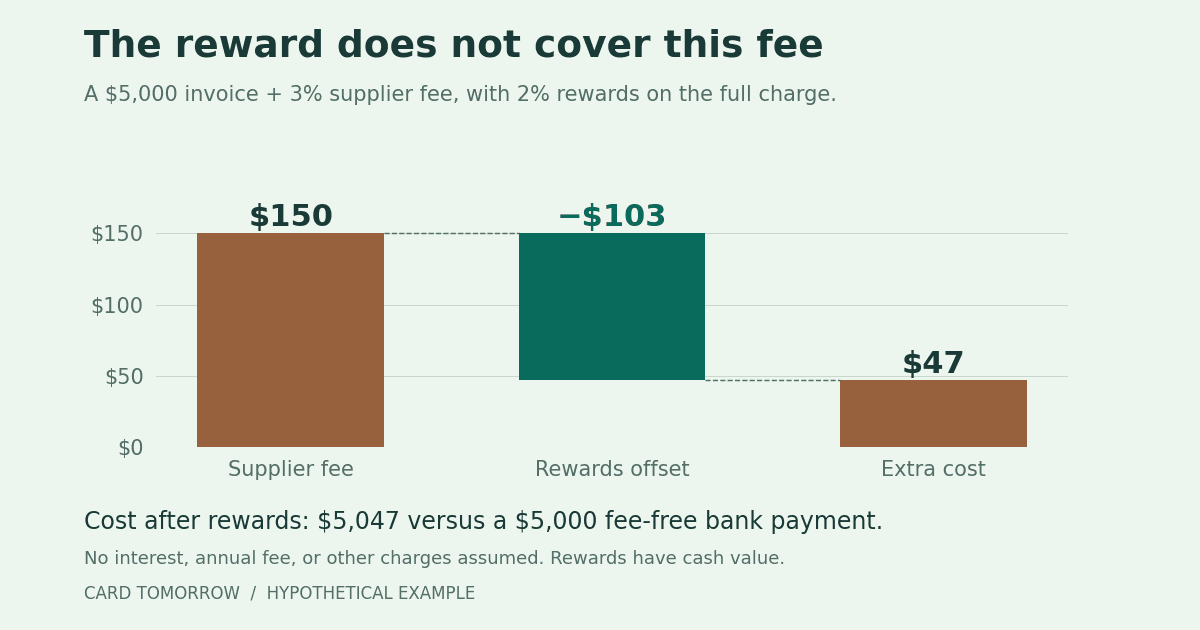
Consider a hypothetical $5,000 supplier invoice. The supplier accepts a bank payment for $5,000, or adds 3% for paying by card. That makes the card charge $5,150.
Assume the whole $5,150 earns 2% cash back with no cap. The reward is $103. Subtract it from the $5,150 charge and the cost is $5,047—still $47 more than the bank-payment option. That is before interest, account fees, or the value of any additional benefit.
| Payment method | Amount paid | Cash rewards | Cost after rewards |
|---|---|---|---|
| Bank payment; no fee assumed | $5,000 | $0 | $5,000 |
| Card; 3% fee; 2% on full charge | $5,150 | $103 | $5,047 |
| Card; 3% fee; 2% on invoice only | $5,150 | $100 | $5,050 |
Check what earns before doing the math
The extra table row matters. If only the underlying $5,000 invoice earns rewards, the return is $100 and the added cost becomes $50. Do not assume that every part of a payment is eligible, or that a supplier’s business description determines its rewards category.
Compare the earning rate for your actual expenses, any cap, and the redemption value you will use. Keep a one-time welcome offer separate from recurring rewards. A setup that works during a bonus period may cost more once that bonus is gone.
Price the borrowing if you will not pay in full
If you will carry the bill beyond the interest-free terms, estimate the financing cost before counting rewards. Check the purchase APR, any promotional end date, and whether the account requires some or all charges to be paid in full. Payment structures differ.
A purchase grace period can make short payment timing useful when you meet its conditions. It is not a permanent line of free financing. For recurring shortfalls, compare a financing option with a repayment schedule suited to the business instead of letting card debt roll forward by default.
Make the account useful for running the business
A card that fits your payment schedule can also simplify expense tracking. Keep business charges separate, match them with invoices or receipts, and check whether the account exports the information you need. If employees use the account, look for practical spending controls.
Before applying, establish who is responsible for repayment and whether a personal guarantee is required. The word business on an account does not settle that question. Read the agreement rather than assuming the business alone carries the risk.
Use three questions to narrow the choice
For each account you are considering, ask: can the business pay it on schedule, what does using it cost, and what useful value remains after those costs? That order keeps a reward headline from deciding how the business borrows.
Use the business category to compare account features and obligations. If payment timing is already comfortable, compare cash-back structures against your ordinary expense mix. The right calculation starts with the invoices you expect to pay, not a spending target you need to invent.
Sources & further reading Checked September 15, 2026
- Business payment timing and expense controlsProvider reference; no publication date shown.
- Business reward structures and repayment responsibilityProvider reference; no publication date shown.
- Earning rates, spending categories, and redemption termsSource dated June 16, 2026.
- Business card payment cycles and account featuresProvider reference; no publication date shown.
- Business account payment structuresCurrent provider comparison; no publication date shown.