The sales pitch was a steep cut in debt, backed by names borrowers already trusted. The Federal Trade Commission says the operation behind it impersonated banks, credit-card companies and government agencies while collecting illegal advance fees.
On October 22, 2026, the FTC announced that a debt-relief operation's corporate defendants had been permanently banned from the industry. The agency says the operation targeted seniors and veterans. The court entered the corporate default judgment on October 14; October 22 is the announcement date.
The case exposes one problem with evaluating a debt-relief offer by its promised savings: the person offering help might not represent the organization they claim to. There is another problem even when the company is real. Sending money into a debt-relief program does not necessarily mean your credit-card company is getting paid.
The borrowed name was part of the offer
According to the FTC, the operation claimed it could reduce consumers' debts by as much as 75% or more. Its operators reached people through telemarketing and through calls consumers placed after seeing direct-mail or online advertising. An offer did not become trustworthy just because the consumer made the first call.
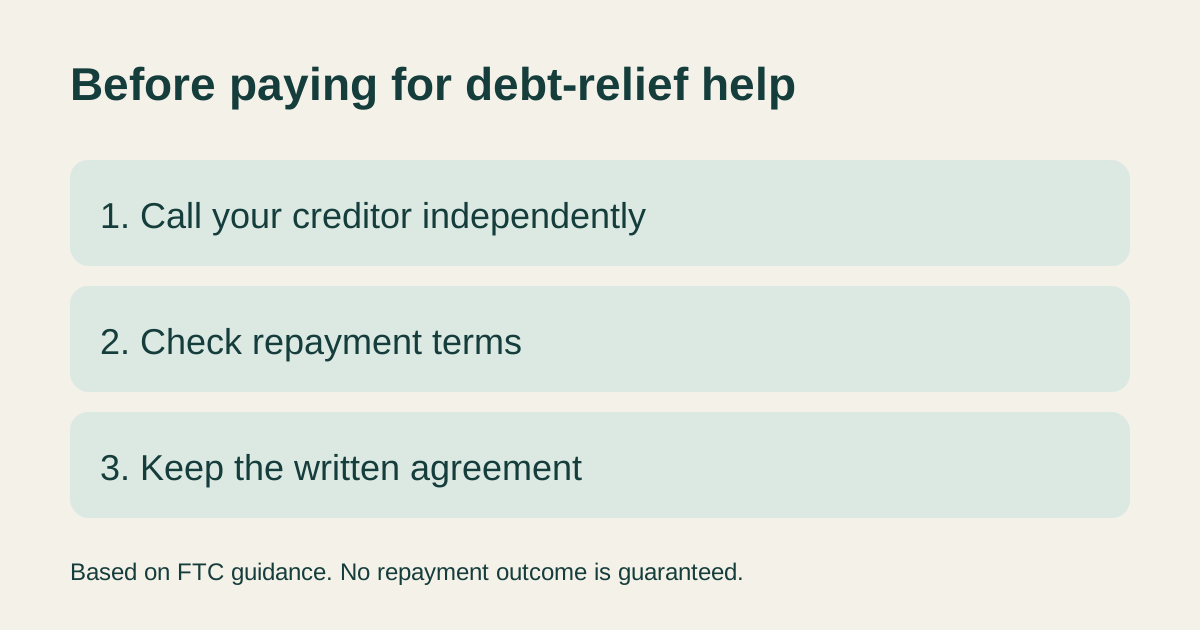
The practical distinction is between answering an advertisement and independently reaching your creditor. The FTC's consumer guide to getting out of debt directs cardholders to the telephone number on their card or statement. That provides a route to ask the creditor about repayment help without relying on the debt-relief seller's claimed affiliation.
That call is also a way to separate help available directly from services someone wants to sell. The FTC says consumers can ask their credit-card company about a lower interest rate or a manageable payment plan themselves, without paying an intermediary. A creditor may negotiate; a particular concession is not guaranteed.
Follow the money, not the label
“Debt relief” is a broad description. Credit counseling, a debt management plan and debt settlement do not do the same thing.
A reputable credit counselor reviews someone's finances before recommending a plan. One option is a debt management plan, which generally works by collecting regular deposits and using them to pay participating creditors on an agreed schedule. Those creditors may lower interest rates or waive certain fees. The purpose is to repay the debts under the plan, not to accumulate money for a possible future bargain.
Debt settlement takes a different approach. Typically, a for-profit company tries to negotiate a payment below the amount owed. The consumer saves toward that payment in a designated account, often while the program encourages them to stop paying creditors. A creditor must agree to a settlement; hiring a company does not require the creditor to accept one.
This explains why a lower monthly deposit can be misleading. A deposit into a settlement account is money set aside for a proposed deal. It is not, by itself, a payment toward the card bill or evidence that a creditor has reduced the balance. In a debt management plan, by contrast, deposits fund scheduled payments to participating creditors.
Before comparing monthly amounts, establish what each amount does: pays a creditor, builds a settlement fund or pays a service fee. Without that distinction, two apparently similar proposals may mean very different things for the unpaid debt.
What happens while a settlement is being negotiated
The waiting period matters. If payments to creditors stop, late fees and interest may build up while money accumulates in the settlement account. Credit scores can fall. Collection calls can continue, and a creditor may sue before an agreement is reached.
A settlement company also may not resolve every debt. The FTC warns that some programs take years and that consumers may struggle to keep saving for long enough to finish. Leaving a program can mean still owing unresolved debts after paying fees for debts already settled. Debt forgiven through a settlement may also have tax consequences.
These are not details to leave until after enrollment. The FTC says a settlement company must disclose its fees and terms, how long it will take to make offers, how much the consumer must save and the possible consequences of stopping payments.
Fees deserve a separate look. The FTC says a debt settlement company cannot collect its fee before settling a debt. When a company settles one debt, it may charge only a portion of its full fee. Money being saved for creditors and money charged by the settlement company are different obligations; a proposal should make both clear.
A useful first conversation produces specifics
For someone struggling with a card bill, the FTC's starting point is the creditor. Having a recent statement and a budget available makes it possible to discuss an amount that fits after essential expenses, rather than accepting a payment because it is lower than the last offer.
The result to seek is a defined arrangement: the payment, any rate or fee changes, the schedule and the next steps. Keep a record of the conversation, request the agreement in writing and retain it until the payments are complete.
Outside help can still be useful, but the organization's status is not a substitute for checking its work. A nonprofit counselor is not automatically free, affordable or legitimate. The FTC recommends checking with a state attorney general or local consumer protection agency and asking about applicable licensing. An absence of complaints is not proof that a business is legitimate.
A counselor should examine the person's finances before recommending a debt management plan. If a plan is proposed, the FTC advises confirming the promised changes with the creditors themselves. That is the difference between a seller describing what might happen and a creditor confirming what it has agreed to do.
Sources and further reading
Sources checked October 22, 2026.
- FTC debt-relief enforcement announcementAnnounced October 22, 2026; corporate default judgment entered October 14, 2026.
- FTC consumer guide: How To Get Out of DebtDated December 2025; checked October 22, 2026.